 how-to
Best Way to Clean Gutters Without a Ladder: 7 Safe Methods
Table of Contents
- Why Cleaning Gutters From the Ground Is Safer and Smarter
- Gutter Cleaning Tools for Ground Use: What Actually Works
- Step-by-Step: The Best Way to Clean Gutters Without a Ladder
- How Often Should You Clean Gutters? A Simple Schedule
- Common Mistakes and Troubleshooting Ground-Level Cleaning
- When to Call Professional Gutter Cleaning Services
- Frequently Asked Questions
Last Updated: September 18, 2026
Why Cleaning Gutters From the Ground Is Safer and Smarter
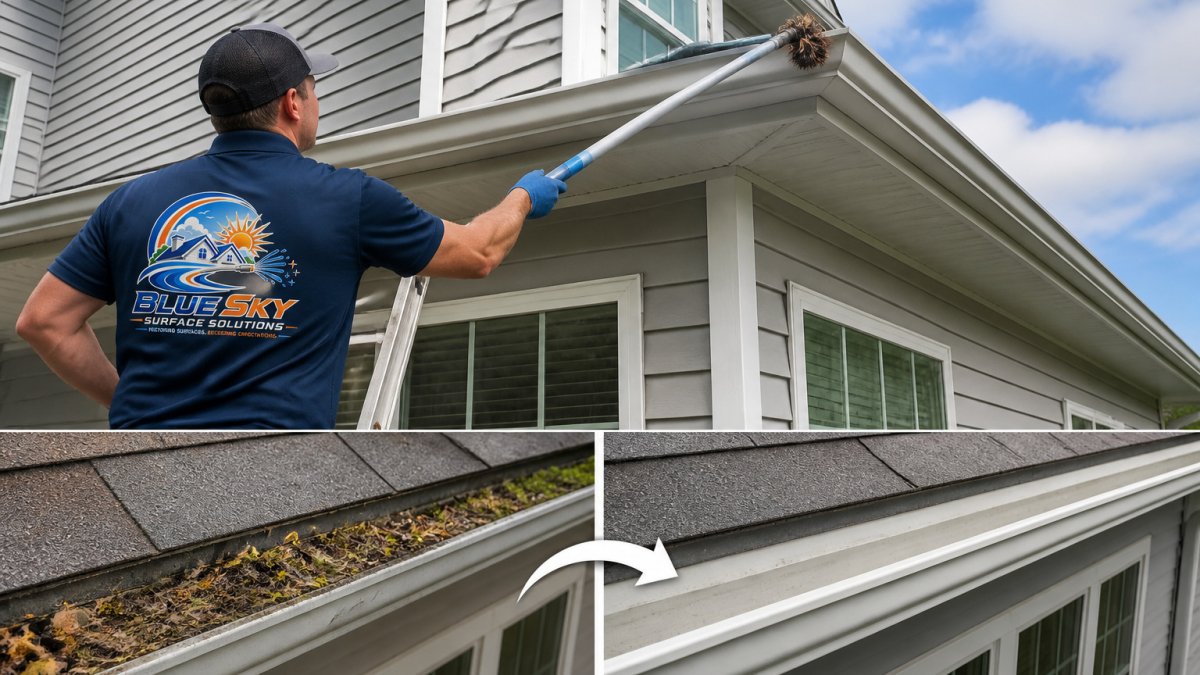
The best way to clean gutters without a ladder is to use a telescopic pole, a hose attachment, or a leaf blower extension from the ground. This approach keeps your feet on the grass and your hands out of danger.
Ladder falls send thousands of people to the emergency room every year, according to the CDC data on fall injuries.
Gutter Cleaning Tools for Ground Use: What Actually Works
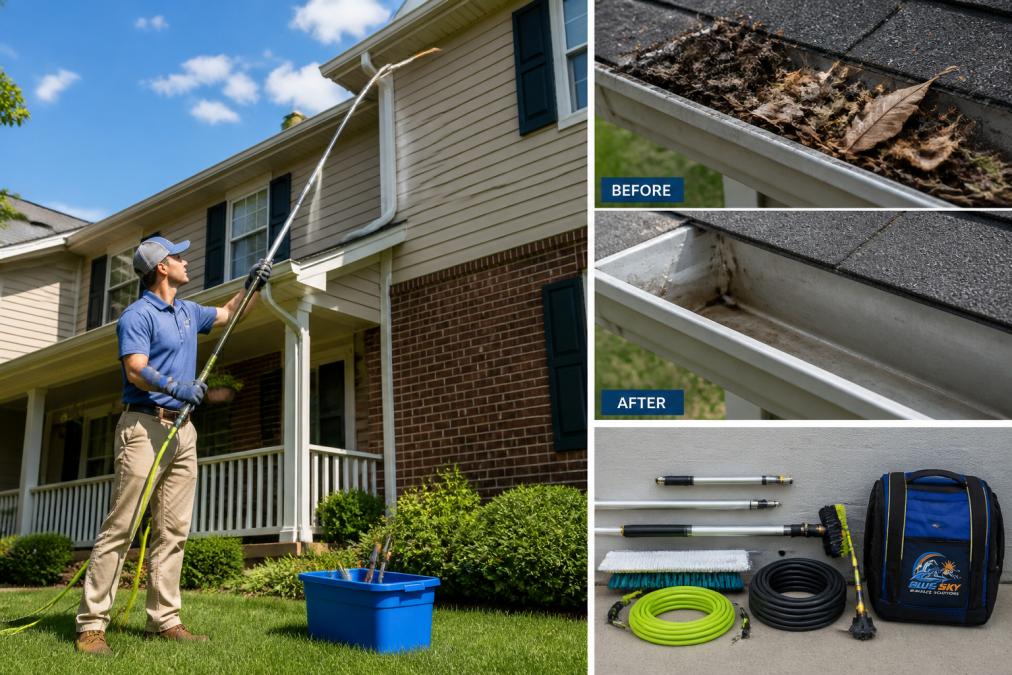
Gutter cleaning tools for ground use fall into four working categories: telescopic poles with hose or scoop attachments, leaf blower extensions, wet/dry gutter vacuums, and gutter cleaning robots. The right pick depends on three variables most guides ignore: your gutter profile, your debris type, and your reach distance.
Match the Tool to Your Gutter Profile First
Not every attachment fits every gutter. Two profiles dominate residential roofs:
- K-style (ogee) gutters: The most common profile on suburban homes. They have a flat back, a decorative front face, and an inward-curling lip. U-bend hose attachments and curved blower tubes are designed for this lip.
- Half-round gutters: Common on older homes and some custom builds. The smooth, semicircular channel means U-bend hooks can slip. You need a rounded scoop or a strap-on nozzle that rides the curve.
- Box gutters and fascia gutters: Found on some older and commercial-style homes. These are wider and often hidden behind a fascia board, which limits what a pole-mounted tool can reach.
Reach Math: How Far Does Your Pole Actually Get You?
A 12-foot telescopic pole does not give you 12 feet of usable reach. Subtract:
- Your own height and arm extension (roughly 6 to 7 feet of working height)
- The angle loss when you tilt the pole to hook the gutter
- The length of the attachment itself
Tool-by-Tool Breakdown
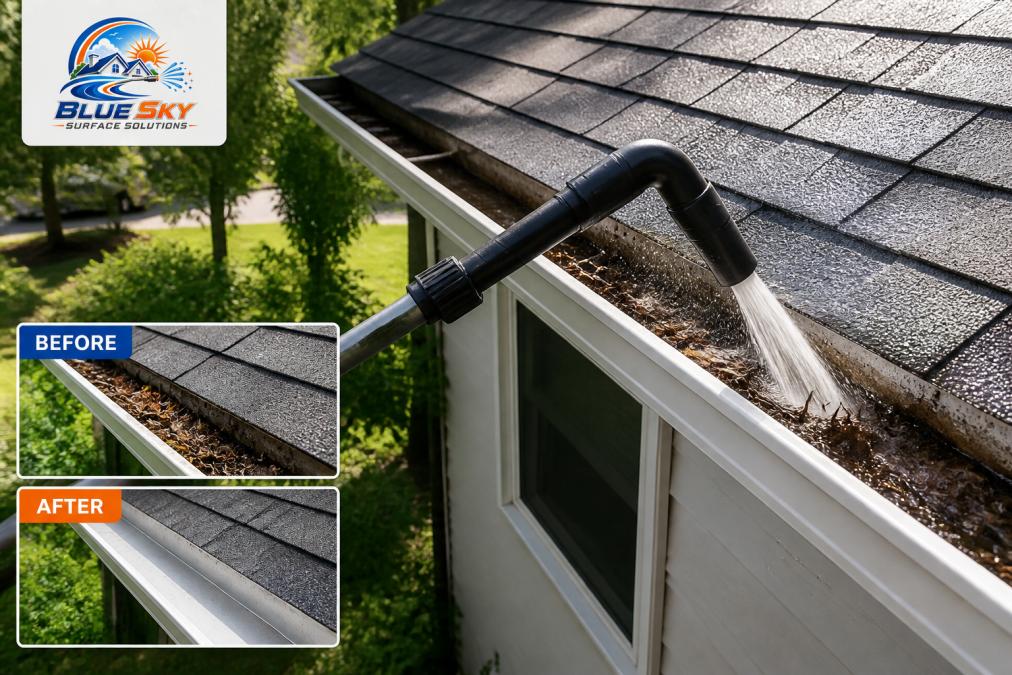
Telescopic pole + hose attachment. Best for light, dry-to-damp debris and for the final rinse. A pistol-grip nozzle with a downward-angled tip pushes debris toward the downspout. Limitation: water alone will not move packed, matted debris, and high pressure can crack seam sealant.
| Tool | Best For | Gutter Profile Fit | Main Limitation |
|---|---|---|---|
| Pole + hose attachment | Light debris, final rinse | K-style; half-round with strap nozzle | Won't clear packed clogs |
| Pole + gutter scoop | Wet leaves, light sludge | K-style; half-round with rounded scoop | Slow; blind on second story |
| Leaf blower extension | Dry leaves, long runs | K-style and half-round | Useless on wet debris |
| Wet/dry gutter vacuum | Wet leaves, heavy buildup | K-style and half-round | Heavy; snags on hangers |
| Gutter cleaning robot | Light debris, long straight runs | K-style mostly | Stalls at hangers and corners |
Step-by-Step: The Best Way to Clean Gutters Without a Ladder
Follow these three steps to clean gutters safely from the ground. The whole job takes about 30 to 45 minutes for an average home. Work on a dry day so debris moves freely.
Step 1: Inspect and Prepare Your Workspace
Walk the perimeter of your home first. Look for sagging sections, rust spots, or loose hangers. Check where downspouts meet the ground.
Step 2: Clear Debris With the Right Tool
Start at the downspout end and work away from it. This pushes debris toward the exit instead of trapping it. Use your pole or blower to pull material out in short passes.
Step 3: Flush and Verify Water Flow
Run water through the gutter with a hose attachment. Watch how fast it drains toward the downspout. Standing water means a clog remains.
How Often Should You Clean Gutters? A Simple Schedule
Most homes need gutter cleaning twice a year: once in late spring and once in late fall. Homes surrounded by trees may need it three or four times. The right schedule depends on what falls on your roof.
Here's a simple way to think about timing:
- Late spring: Clear pollen, seed pods, and spring storm debris
- Early summer: Quick check after heavy storms
- Late fall: Remove leaves before winter freezes them in place
- After any major storm: Inspect for damage and blockages
Common Mistakes and Troubleshooting Ground-Level Cleaning
Ground-level cleaning fails for predictable reasons. Knowing them, and knowing when to stop, saves you a second trip up the pole and a call to a pro.
Verify the Job From the Ground
Removal is not the finish line. Verification is. Most guides stop at "flush with water," which tells you almost nothing about whether the system actually drains.
- Mirror pole check. Tape a small convex mirror to the end of a pole and angle it into the gutter channel. You can see remaining debris, standing water, and sagging sections without climbing.
- Camera pole or phone-on-pole. A phone clamped to a pole with the camera facing the gutter gives you a clear view of the channel and the downspout opening. Review the footage on the ground.
- Flow test at the downspout. Run water into the gutter at the far end from the downspout. Time how long it takes to exit the bottom. A steady, unobstructed flow means the run is clear. A trickle, a gurgle, or no flow means a blockage remains.
- Sight line along the gutter edge. Stand back and look along the gutter's front edge. A straight line means the pitch is intact. A dip or a low spot means water will pool there even after cleaning.
When to Give Up and Call a Pro
- The clog won't budge after two full passes. If a hose, blower, and vacuum have each failed on the same section, the debris is likely packed, matted, or wedged behind a hanger. More passes risk bending the gutter or cracking a seam.
- Water still pools after a clear flow test. That points to a pitch problem, a crushed downspout, or a blockage below the visible run. These are repair jobs, not cleaning jobs.
- You see sagging, pulling hangers, or separated seams. Continuing to work the gutter can pull it further off the fascia and turn a cleaning into a re-hang.
- The debris is wet and heavy across the whole run. Wet, matted debris is the number-one reason ground-level jobs fail. A pro crew has the vacuum capacity and the reach to clear it in one visit.
- Your home has three or more stories, or the gutter sits above a steep roof pitch. No pole safely reaches that, and the risk of a fall or a dropped tool goes up sharply.
- You spot mold, pest nests, or standing water you can't clear. These need more than a cleaning pass.
Blue Sky Surface Solutions handles the stubborn jobs ground-level tools can't finish, along with house washing, soft washing, and tree services for homeowners across Hamilton County. Contact us for professional service at a great price, and let one call cover the whole exterior.
When to Call Professional Gutter Cleaning Services
Some jobs need more than a pole and a hose. Professional gutter cleaning services make sense in several situations:
- Your home has three or more stories
- Gutters are damaged, sagging, or pulling away from the house
- You spot mold, pest nests, or standing water you can't clear
- Debris is packed so tight your tools can't break it loose
- You simply don't have the time or comfort level for the job
Frequently Asked Questions
What is the best tool to clean gutters without a ladder?
A telescopic pole with a hose attachment or a leaf blower extension kit works best for most homes. Choose a pole that reaches your gutter height, typically 12 to 24 feet. For heavy debris, use a gutter scoop attached to the pole. If you have a gutter vacuum, it can handle wet leaves and sludge. Match the tool to your debris type and gutter style for the easiest job.
How do I clean gutters I can't reach?
Use a telescopic pole with a curved nozzle or a leaf blower extension to reach high gutters from the ground. Stand back and aim the tool along the gutter channel. For stubborn clogs, a pressure washer attachment with a U-bend can flush debris toward the downspout. Always keep both feet on the ground and never lean a ladder against the gutter.
What should you not use to clean gutters?
Avoid using a high-pressure spray directly on gutter seams, as it can loosen joints and cause leaks. Never use a metal rake or sharp object that can scratch the gutter surface. Do not use chemical drain cleaners; they can damage plants and pollute runoff. Also, skip homemade wire hooks that may bend the gutter edge.
How often should you clean gutters in Indiana?
Most homes need gutter cleaning at least twice a year, in late spring and late fall. If you have many trees near your roof, clean every three to four months. After heavy storms, check for debris buildup. Homes with pine needles or maple seeds may need more frequent cleaning. Regular maintenance prevents clogs and water damage.
Cleaning your gutters from the ground is safer and simpler than most people think. But some jobs call for a trained eye and the right equipment. If your gutters are damaged, hard to reach, or overdue for a deep clean, Blue Sky Surface Solutions can help. Our team handles gutter cleaning, soft washing, house washing, and tree services to protect your home and its curb appeal. Get started with Blue Sky Surface Solutions and keep your exterior looking its best year-round.