 how-to
How to Identify Hazardous Trees in Your Yard Safely
Table of Contents
- Why Identifying Hazardous Trees Matters for Home Safety
- Your Tree Risk Assessment Checklist: What to Look For
- When to Remove a Tree: Decision Framework
- Professional Tree Inspection Services vs. DIY Checks
- The Hidden Risks: Roof Damage, Gutters, and Property Value
- Preventative Maintenance: Keeping Trees Safe Long-Term
- Conclusion: Protect Your Home with Expert Tree Care
- Frequently Asked Questions
Last Updated: October 2, 2026
Why Identifying Hazardous Trees Matters for Home Safety
A leaning oak looks charming until a storm drops a limb on your roof.
Trees fail for predictable reasons.
Most homeowners judge a tree by its leaves, but a tree can look perfectly green and still be a hazard.
Below, we'll show you what to check, when to call a professional, and how to protect your home before the next storm season.
Your Tree Risk Assessment Checklist: What to Look For
A tree risk assessment checklist systematically evaluates whether a tree threatens people or property. It covers four zones: the trunk, the roots, the branch structure, and the canopy.
Zone 1: The Root Zone and Root Flare
The root flare is where the trunk widens into the ground. On a healthy tree it should be visible, with buttress roots spreading outward. If it's buried under mulch or soil, the roots stay too wet and the tree loses anchorage over time.
What to check:
- Soil heaving: A mound or crack in the soil on one side of the trunk often means the root plate is lifting.
- Exposed roots: Roots cut by a mower, edger, or trenching for a sprinkler line lose holding power permanently.
- Fungal growth at the base: Shelf-like growths or clusters of mushrooms at the base mean the wood inside is being consumed. Do not ignore these because the canopy still looks green.
- Mulch volcanoes: Mulch piled against the trunk holds moisture against the bark and invites problems. Pull it back so the flare is visible.
A common pattern is a tree that survived construction for five years and then failed in a windstorm. Root damage from grading, paving, or trenching shows up years later, not immediately.
Zone 2: The Trunk
Work around the trunk at eye level and again at chest height, looking for anything that breaks the normal pattern of the bark.
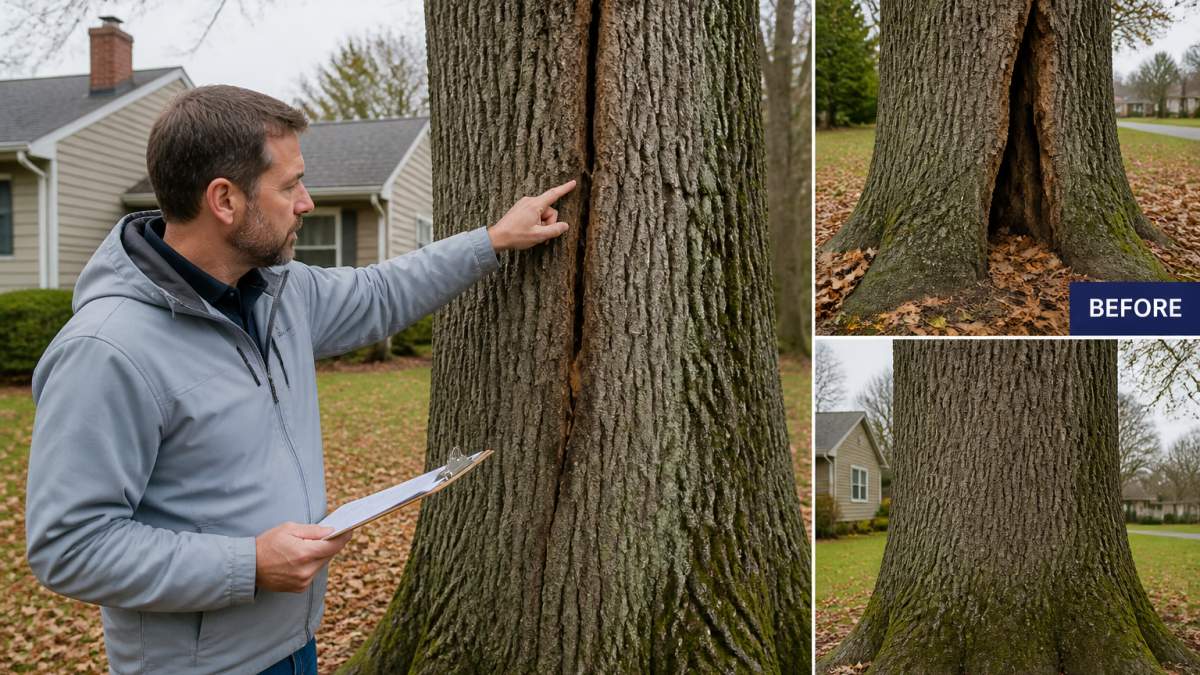
- Vertical cracks and seams: A crack that runs with the grain and opens and closes with the seasons is less alarming than one that is deep, dark, and spreading.
- Hollow sounds: Tap the trunk with a rubber mallet or the handle of a tool. A sharp ring means solid wood. A dull thud suggests a cavity inside.
- Missing bark: Large patches of exposed, smooth wood mean the cambium is dead in that area.
- Sap or sawdust: Fresh sawdust at the base or oozing sap can point to insect activity or internal failure.
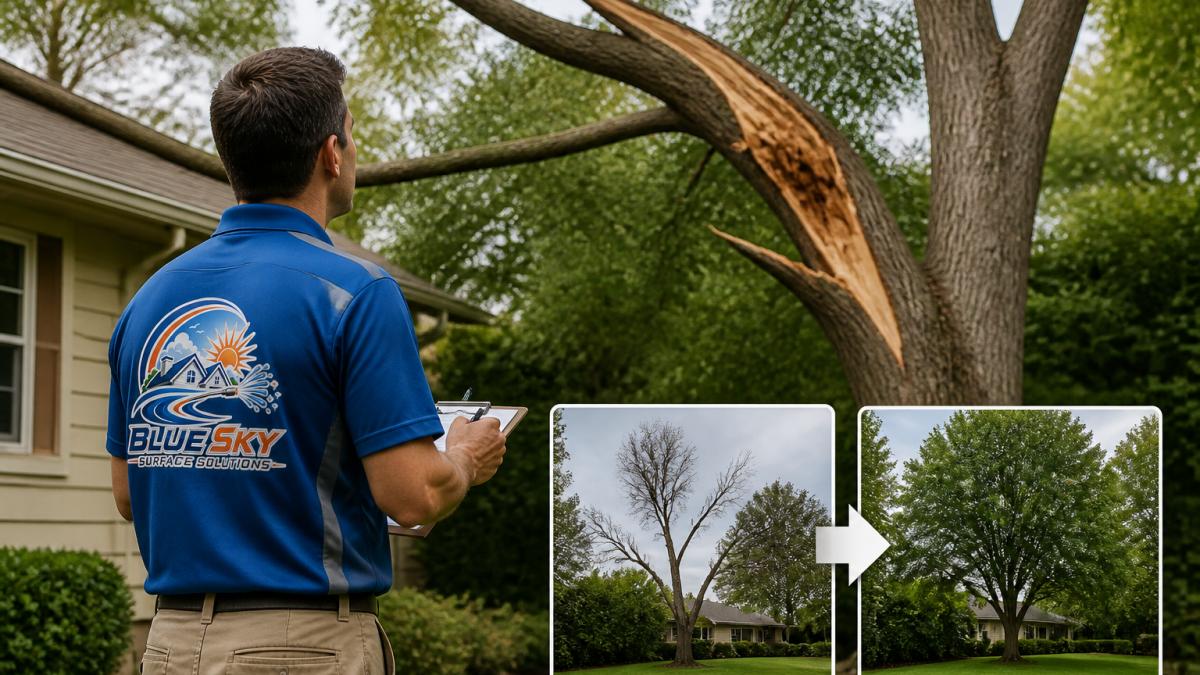
- Two trunks, one point: A trunk that splits into two leaders from the same point has a weak union that can tear apart in wind.
Zone 3: Branch Structure and Unions
Look up into the crown from several angles. Branch attachments tell you more about storm risk than almost anything else.
- Bark included in the union: On a strong branch, the bark ridge dips down into the crotch. If bark is pinched between the branch and trunk, the union is weak.
- V-shaped forks: A narrow V is weaker than a wide U. The narrower the angle, the more leverage a storm has.
- Crossing and rubbing branches: Constant friction wounds the bark and creates an entry point.
- Deadwood: Dead branches are brittle and drop without warning. Look for bare limbs in a full canopy.
- Hangers: A broken branch caught in the canopy is a hazard that can fall at any time, even on a calm day.
Zone 4: The Canopy and Overall Form
Step back to see the whole tree, then look for these patterns:
- Thinning on one side only: A canopy that is losing foliage on one side can mean the roots on that side are compromised.
- Sudden lean: A new lean is far more serious than a lean the tree has had for years. Compare against an old photo if you have one.
- Epicormic sprouts: Dense shoots growing straight up from the trunk or along a limb often appear when a tree is under stress and trying to replace lost canopy.
- Dead top: A crown that dies back from the top down is a serious structural signal.
Rate the Target, Not Just the Tree
A defect only becomes a hazard when something is in the fall zone. A tree's height roughly equals its fall radius, so a 60-foot oak can reach 60 feet in any direction.
Score each tree on defect severity and target value, and act on the trees that score high on both, the same logic a professional uses, just without the instruments.
If any zone check leaves you unsure, get a second set of eyes. Our team at Blue Sky Surface Solutions can walk your property, flag the trees that matter, and handle trimming or removal in the same visit.
When to Remove a Tree: Decision Framework
Removal is the right call when a tree's structural defects can't be corrected and the target below is a home, driveway, or play area. Pruning can buy time on some trees; on others it just moves the failure point higher up.
| Situation | Action | Urgency |
|---|---|---|
| Large dead branches over roof | Remove branches | Within 2 weeks |
| Trunk crack with fungal growth | Full removal | Within 1 week |
| New lean toward structure | Professional evaluation | Immediately |
| Minor deadwood, no target | Monitor and prune | Next season |
| Root damage from construction | Professional evaluation | Within 1 month |
| Two leaders with included bark over a driveway | Full removal or cable and brace | Within 1 month |
| Hanger caught in canopy | Remove branch | Same day |
The "target" matters as much as the defect. A cracked tree in an empty field is low priority; the same tree next to a bedroom is high priority.
Prune, Cable, or Remove?
Not every risky tree has to come down. There are three options, and they aren't interchangeable.
- Pruning removes weight and leverage from the ends of limbs. It works when the defect is in the outer canopy and the trunk and roots are sound.
- Cabling and bracing installs steel hardware to hold a weak union together. It is a reasonable option for a high-value tree with a single weak fork, but it requires periodic inspection and is not a fix for a decaying trunk.
- Removal is the only option when the defect is in the trunk, the root plate, or the lower structure, because there is nothing left to support the tree.
A common mistake is pruning a tree with a failing root plate. Cutting limbs makes the tree lighter but doesn't restore anchorage, and it can still go over in saturated soil.
The Hidden Cost of Waiting
Delaying removal rarely saves money. A tree that fails on its own schedule lands wherever gravity and wind decide, usually the roof, fence, or car. Planned removal lets the crew control the fall direction, work around landscaping, and clean up in one pass.
There's a second cost most guides skip: your roof warranty and insurance coverage may not protect you if the tree was visibly failing and you did nothing.
What to Have Ready Before You Call
You'll get a faster, more accurate assessment if you can hand over a few things:
- Photos of the tree from two or three angles, including the base and the canopy
- A rough measurement of trunk diameter at chest height
- A note on what the tree overhangs, roof, driveway, power drop, or open ground
- Any change you have noticed recently, such as new lean, dead limbs, or sprouts on the trunk
That lets a professional tell you on the phone whether you're looking at a routine prune or an urgent removal, and helps you get a fair, accurate quote instead of a guess.
If you'd rather not make the call yourself, that's exactly what we're here for. Blue Sky Surface Solutions inspects, prunes, removes, and hauls away the debris, and we'll tell you honestly when a tree can stay.
Professional Tree Inspection Services vs. DIY Checks
Professional tree inspection services use tools and training homeowners don't have. An arborist can detect internal decay with a resistograph, assess root stability, and grade risk on a standard scale. A DIY check catches the obvious problems; a professional catches the ones you can't see.
Here's the honest trade-off:
DIY checks are good for:
- Spotting visible cracks, fungus, and deadwood
- Tracking changes season to season
- Flagging trees that need a closer look
Professional inspections are needed for:
- Any tree within striking distance of your home
- Trees with multiple defects
- Large trees over 20 inches in trunk diameter
- Trees that have shifted after a storm
At Blue Sky Surface Solutions, our team handles both the inspection and the work that follows, trimming, removal, and gutter cleaning when nearby trees pack your gutters with debris.
The Hidden Risks: Roof Damage, Gutters, and Property Value
A hazardous tree damages more than the branch it drops. Falling limbs strip shingles, dent gutters, and clog downspouts.
Roof granules wear away faster under constant debris, and when you sell, a buyer's inspector will flag overhanging limbs as a maintenance risk.
Here's the part most guides skip: your roof warranty may not cover damage from neglected trees.
The fix is straightforward. Trim back limbs that overhang the roof. Keep gutters clear.
Preventative Maintenance: Keeping Trees Safe Long-Term
Preventative maintenance is cheaper than emergency removal every time. A tree pruned properly every few years develops stronger branch unions and better structure.
Build this schedule into your year:
- Spring: Inspect for winter damage and deadwood.
- Summer: Watch for fungal growth after wet spells.
- Fall: Clear leaves and debris from around the root zone.
- Winter: Prune dormant trees to shape structure.
Proper pruning matters more than frequent pruning. Cutting too much at once stresses the tree and causes weak, fast sprouts that break easily later.
Ventilation and sunlight also play a role. Trees packed too closely hold moisture, which speeds decay.
If you're not comfortable making these calls yourself, that's normal.
Conclusion: Protect Your Home with Expert Tree Care
Spotting a hazardous tree early protects your roof, your gutters, and your family. But some risks hide below the bark, and that's where a trained eye pays off. Blue Sky Surface Solutions offers professional tree services, house and gutter cleaning, and soft washing across Hamilton County. Our team inspects, trims, removes, and cleans up, so your property stays safe and sharp year-round.
Frequently Asked Questions
What are the signs of a dying tree in my yard?
Look for dead branches, especially in the upper canopy, and check for brittle bark that falls off easily. A lack of new growth in spring, sparse leaves, or mushrooms growing at the base can indicate decline. If more than 50% of the tree is dead, removal is often safer than trying to save it.
How do I know if a tree is at risk of falling?
A tree at risk of falling often shows a sudden lean, cracks in the trunk, or soil heaving around the base. Dead or broken branches hanging in the canopy are also warning signs. If you see any of these, keep people and pets away and contact a professional tree inspection service for an assessment.
Can a tree look healthy but still be hazardous?
Yes. Some trees have internal decay or root damage that isn't visible from the outside. A tree may have a full canopy but a hollow trunk or compromised roots. This is why a professional tree risk assessment checklist includes checking for cavities, fungal growth, and soil movement, not just outward appearance.
How often should I have my trees inspected?
Most trees should be inspected annually, but those near your home, driveway, or power lines may need a check every six months. After severe storms or if you notice changes like leaning or cracks, schedule an inspection immediately. Regular preventative maintenance can catch problems before they become dangerous.