 blog
Professional Gutter Cleaning: Costs, Tools & Tips
Table of Contents
- Why Professional Gutter Cleaning Protects Your Home
- What a Gutter Cleaning Cost Estimate Actually Includes
- How Often to Clean Gutters in Indiana
- Gutter Cleaning Tools Used by Professionals
- Signs Your Gutters Need Cleaning Now
- Gutter Guards, Seasonal Schedules, and Insurance
- How to Choose a Professional Gutter Cleaning Service
- Frequently Asked Questions
Last Updated: September 12, 2026
Why Professional Gutter Cleaning Protects Your Home
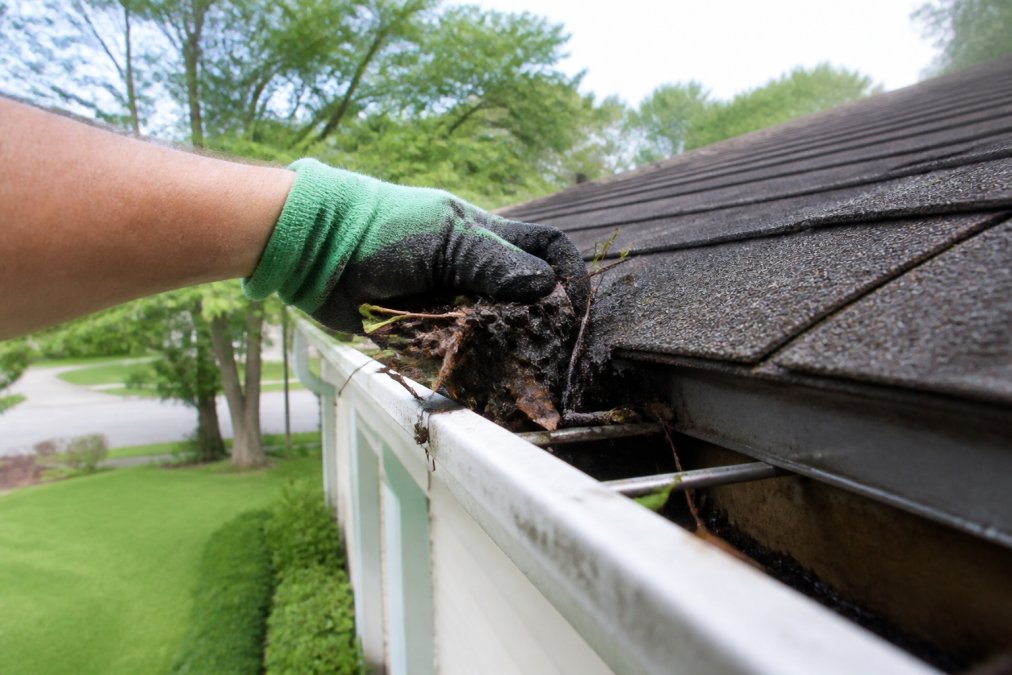
Professional gutter cleaning is the scheduled removal of leaves, twigs, granules, and sludge from a roof drainage system, plus a flush of every downspout to confirm water moves away from the structure. Left alone, that debris turns a working system into a clogged channel that pushes water into fascia boards, soffits, and foundations.
The damage rarely announces itself. Water backs up under the roof edge, rots the fascia board, and seeps behind siding before a homeowner notices a stain on the ceiling. Foundation protection works the same way: when gutters overflow at the base of the house, soil shifts, and cracks follow.
Blue Sky Surface Solutions handles this work across Hamilton County, and the pattern we see is consistent. Homeowners who treat gutter maintenance as preventative maintenance spend far less than those who call after water damage prevention has already failed. According to FEMA guidance on protecting your home from water damage, water is one of the most common and costly sources of residential property damage, which makes roof drainage a structural issue, not a cosmetic one.
Below, we'll show you how often to schedule one, and how to tell when debris removal can't wait.
What a Gutter Cleaning Cost Estimate Actually Includes
A gutter cleaning cost estimate is typically priced on linear footage, roof height, pitch, and the number of stories, not on a flat rate. Two houses on the same street can land in very different brackets.
Typical estimates account for:
- Total gutter run length and downspout count
- Roof height, pitch, and ladder accessibility
- Debris volume, especially after leaf buildup season
- Whether gutter guards are present and need clearing
- Add-ons like gutter repair or resealing
Pricing depends on your home's specific configuration, so we don't publish flat rates. Request a service quote and Blue Sky Surface Solutions will walk the property, count the runs, and give you a firm number before any work begins.
How Often to Clean Gutters in Indiana
Twice a year is the baseline for most homes, with a third visit in heavy tree cover (extension.psu.edu). The right frequency depends on what surrounds your roof, not the calendar alone.
| Situation | Recommended Frequency | Why |
|---|---|---|
| No overhanging trees | 2x per year (spring, late fall) | Standard leaf buildup and shingle granule accumulation |
| Mature trees nearby | 3-4x per year | Constant leaf and seed drop clogs downspouts fast |
| After a major storm | Immediate inspection | Debris and shingle damage change water runoff paths |
| Gutter guards installed | 1-2x per year | Guards reduce debris but don't eliminate maintenance |
Seasonal cleaning matters more than most homeowners expect. Late fall clears the bulk of leaf drop before winter freeze, and spring removes what winter left behind. Skipping the fall visit means ice dams and standing water sit against your roof edge for months (weather.gov).
Gutter Cleaning Tools Used by Professionals
The tools professionals use differ from what you'll find in a homeowner's garage, and that gap is the main reason DIY results don't match. A gutter vacuum system can pull debris from the roofline without the technician leaning over the edge, while pressure washing can clear the stubborn film that hand scooping leaves behind.
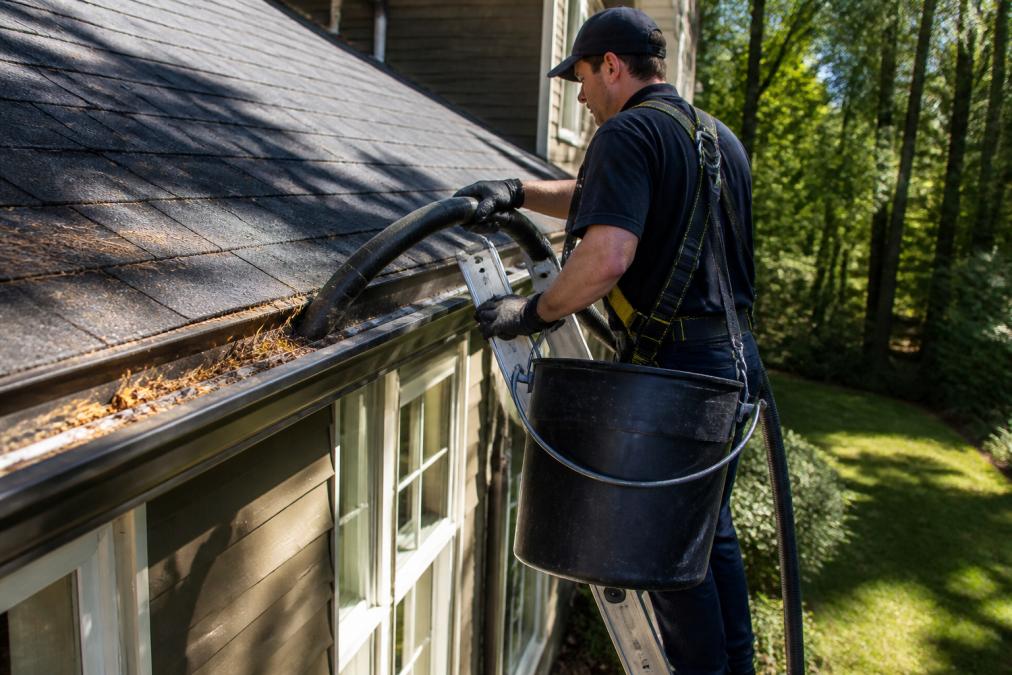
A professional kit may include:
- A gutter vacuum system with telescoping poles for reach
- Hand scoops and trowels for packed debris
- A pressure washing setup for flushing downspouts
- Standoff stabilizers and harnesses for ladder safety
- Drop cloths and buckets to protect landscaping below
The Process, Step by Step
Tools only matter because of how they're sequenced. A thorough visit follows a repeatable order, and skipping a step is what leaves a clog behind:
- Walk the property and document. The technician may photograph the gutter channel, downspout openings, and any existing damage before touching anything. This can serve as a baseline for the before-and-after record.
- Set up fall protection and ground protection. Standoff stabilizers keep the ladder off the gutter edge, and drop cloths catch debris so it doesn't stain siding or smother landscaping.
- Remove dry solids first. Hand scoops and trowels pull the packed leaf mass out of the channel. This step is non-negotiable, flushing before scooping pushes the plug straight into the downspout.
- Vacuum the residual film. A gutter vacuum lifts the fine grit, shingle granules, and seed pods that scoops leave behind. This is the layer that re-clogs a "clean" gutter within weeks.
- Flush every downspout. Water is run through each downspout to confirm it drains freely and exits away from the foundation. A downspout that backs up is a clog the scoop never reached.
- Inspect and reseal. Loose hangers, separated seams, and failing sealant get flagged or may be repaired in the same visit.
- Bag and remove debris. Nothing is left on the roof or in the yard.
How Gutter Guards Change the Tools and the Method
Gutter guards are the variable most quotes ignore, and they change both the price and the technique. A guard system that blocks large leaves still lets pine needles, shingle granules, and seed pods through, and those fine particles settle in the channel where a vacuum can't always reach them.
- Mesh and micro-mesh guards filter fine debris well but require the technician to lift or remove panels to clear the channel underneath, which adds labor time.
- Reverse-curve and surface-tension guards shed large leaves but can trap moisture and grit against the roof edge if they aren't pitched correctly.
- Foam and brush inserts sit inside the channel and must be pulled, cleaned, and reinstalled, a step that isn't part of a standard cleaning quote.
Ask what your guard is rated for before assuming it ends maintenance. A guard that isn't matched to your debris type can potentially cost more to clean than an open gutter, as it may require the technician to disassemble and reassemble the system on every visit. If you're pricing a cleaning on a guarded home, confirm the quote includes guard removal and reinstallation, otherwise you might be paying for a surface rinse that leaves the channel full.
Signs Your Gutters Need Cleaning Now
Visible overflow is the clearest sign, but it's rarely the first one. Water spilling over the front edge during rain means the system is already failing.
Watch for these signals:
- Water staining or streaks on the fascia board and soffit
- Plants or moss growing out of the gutter channel
- Sagging gutter sections pulling away from the roofline
- Water pooling at the foundation after storms
- Birds or insects nesting in the channel
- Visible leaf buildup or standing water at the top of a downspout
Any one of these means scheduling should move up. Two or more usually means clogged gutters are already affecting the home exterior maintenance schedule and possibly the roof itself.
Gutter Guards, Seasonal Schedules, and Insurance
Gutter guards reduce how often you clean, but they don't eliminate the job. Fine debris, shingle granules, and seeds still settle in the channel, and a guard that isn't matched to your debris type can trap moisture against the roof edge.
Compatibility comes down to debris. Pine needles and roof grit slip through mesh guards, while large leaves are blocked well. Ask what your guard is rated for before assuming it ends maintenance.
A Seasonal Schedule That Follows Your Foliage, Not the Calendar
"Twice a year" is a starting point, not a plan. The right schedule tracks what actually falls on your roof, and that varies by tree species and climate. A workable framework:
| Season | What's Falling | What to Do |
|---|---|---|
| Early spring | Seed pods, pollen, winter grit, shingle granules | Clear the channel and flush downspouts after the last freeze |
| Late spring | Flowering tree debris, cottonwood fluff | Spot-check if you have cottonwoods or similar; fluff mats down and blocks flow |
| Summer | Minimal leaf drop, but algae and moss growth | Inspect for moss and algae; treat before it roots into the channel |
| Early fall | First leaf drop from early-turning species | Optional pre-clean if you're surrounded by maples or similar |
| Late fall | Bulk leaf drop | The most important visit of the year, clear everything before the first hard freeze |
| Winter | Ice, snow, and freeze-thaw cycles | Post-storm inspection; ice dams form when the fall visit was skipped |
Homes with no overhanging trees can often hold at two visits. Homes under mature pines, oaks, or cottonwoods may need three or four. The fall visit is the one that prevents ice dams, because standing water that freezes at the roof edge backs up under the shingles.
Eco-Friendly Cleaning Without Harming the Landscape
Debris removal is mechanical, but the treatments used for moss and algae are where landscaping damage can happen. A few practices that can help keep the job clean:
- Skip bleach-based washes near plantings. Runoff carries chlorine into soil and can burn shrubs and grass at the drip line.
- Use low-pressure rinses for algae film. High pressure strips shingle granules and drives water behind siding.
- Capture debris rather than washing it off the roof. Drop cloths and buckets keep leaf mass out of flower beds and storm drains.
- Treat moss at the root, not the surface. Oxygen-based cleaners break down into water and oxygen and are gentler on nearby plantings than harsh solvents.
Insurance, Liability, and Why It Matters
Insurance and liability deserve more attention than they get. A clogged gutter that causes interior water damage may not be covered if the insurer determines the damage resulted from neglected maintenance. Homeowners insurance typically responds to sudden events, not slow deterioration. Check your policy language and keep records of every service visit.
The liability side is separate and just as important. Anyone working at roof height on your property carries risk, a fall, a dropped tool, a ladder through a window. If the worker is an uninsured individual rather than a covered company, that risk can land on your homeowners policy. Before you book:
- Ask for a certificate of insurance showing general liability coverage.
- Confirm the policy is current, not just that one exists.
- Ask whether workers are covered for injuries sustained on your property.
- Keep the before-and-after photos and the invoice, they document that maintenance was performed if a claim is ever questioned.
A provider who carries liability insurance and documents each visit protects you twice: once from the physical risk of the work, and once from the financial risk if something goes wrong.
Seasonal maintenance schedules can be effective when they pair with the rest of your home exterior maintenance: gutter cleaning in late fall and a post-storm check after any major weather event.
How to Choose a Professional Gutter Cleaning Service
Choose a provider that inspects before it quotes, carries liability insurance, and puts its scope in writing. Everything else is secondary.
When choosing a professional gutter cleaning service, consider asking these questions:
- Does the quote include flushing every downspout?
- Are the technicians insured for work at height?
- Do they photograph the gutters before and after?
- [ ]
- Do they offer gutter repair and minor resealing?
- Can they document the site visit for your insurance records?
Blue Sky Surface Solutions quotes after a site visit, not over the phone, so the number reflects your actual roofline. That visit also surfaces gutter repair needs, loose hangers, and downspout issues that a phone quote would miss.
Frequently Asked Questions
Is professional gutter cleaning worth it?
Yes, for most homeowners. Clogged gutters cause overflow that damages fascia boards, soffits, and foundations. Professional gutter cleaning uses proper equipment and ladder safety to remove debris completely. It also includes a roof inspection and minor gutter repair check. The cost of water damage prevention is far less than repairing structural damage from neglected gutters.
How much should gutters cost to clean?
Pricing depends on home height, gutter length, debris volume, and whether gutter guards are present. A gutter cleaning cost estimate should account for site visit, scheduling, and service pricing variables. Blue Sky Surface Solutions provides free quotes based on your specific property. Contact us for current pricing rather than relying on generic averages.
How often should you schedule professional gutter cleaning?
Most homes need gutter cleaning at least twice yearly: late spring and late fall. Homes surrounded by trees may need quarterly seasonal cleaning. In Hamilton County, heavy leaf buildup after autumn makes late fall critical. Regular gutter maintenance prevents clogged gutters and water runoff issues that lead to foundation protection problems and costly repairs.
Do professional gutter cleaners also perform minor repairs?
Minor gutter repairs, such as addressing loose fasteners, sagging sections, or leaks at joints, may be performed during a cleaning visit. Resealing seams and reattaching downspouts are also common services. Inquire about specific gutter repair and inspection services included with standard cleaning.
Clogged gutters quietly undermine your roof, siding, and foundation, and the repair bill always exceeds the cost of staying ahead of them. Blue Sky Surface Solutions provides professional gutter cleaning, soft washing, and tree services across Hamilton County, with a full site visit before every quote and a team that documents the work from start to finish. Get started with Blue Sky Surface Solutions and protect your home's structural integrity with dependable, scheduled exterior maintenance.