 blog
House Washing Cost: What Homeowners Pay
Last Updated: November 1, 2026
Quick Summary
House washing cost depends mainly on the size of your home, the material of your siding, and how dirty the exterior has become. Two-story homes, tight access, and heavy mildew or algae add to the price. Blue Sky Surface Solutions gives homeowners a clear, line-by-line picture of what drives their estimate.
- Surface area of the home is the biggest factor, since more siding takes more time and solution.
- Vinyl, wood, stucco, and brick each need a different cleaning approach and can shift the price.
- Heavy buildup takes longer to remove than light dirt, so it is priced as a separate adjustment.
- Ask each provider which method they will use and what pressure they will run at the surface.
- Many homeowners wash once a year, and regular cleaning can keep each visit lighter over time.
Table of Contents
- What Affects House Washing Cost
- Soft Washing Versus Pressure Washing: How the Methods Compare
- How Home Size and Siding Type Change Your House Washing Estimate
- What a House Washing Quote Includes and Excludes
- How Long Does It Take to Wash a House?
- How Often to Wash a House and What That Does to Your Budget
- Booking Your House Washing Estimate With Blue Sky Surface Solutions
- Frequently Asked Questions
House washing cost depends on the size of your home, the material of your siding, and how dirty the exterior has become. Blue Sky Surface Solutions works with homeowners to clean exteriors safely and at a price that makes sense. Our goal is to give you a clear picture of what drives the number on your estimate, so you can compare quotes with confidence.
What Affects House Washing Cost
Several factors move the price up or down. The biggest is the surface area of the home, since more siding takes more time and more cleaning solution. Building height matters too, because a two-story home requires extended reach equipment and more careful setup.
Other factors include:
- Siding material: Vinyl, wood, stucco, and brick each need a different approach.
- Level of buildup: Heavy mildew, algae, or grime takes longer to remove than light dirt.
- Access: Tight side yards, landscaping that must be protected, and fenced areas slow the crew down.
- Extras: Decks, fences, and walkways are often quoted separately from the main house.
Many homeowners find that the condition of the exterior matters more than the raw size. A lightly soiled home can cost less than a larger home that has years of buildup.
Soft Washing Versus Pressure Washing: How the Methods Compare
Most homeowners hear "house washing" and picture a pressure washer. Our guide to cleaning siding safely explains each step and how the method affects the siding before you choose a service. In practice, the two methods are different tools with different price logic, different surface lists, and different risk profiles. Comparing quotes only works when you know which method each provider intends to use, and why.
The two methods, side by side
| Dimension | Soft washing | Pressure washing |
|---|---|---|
| Water pressure | Low, typically under 500 PSI at the surface, often much less | High, commonly 1,500-4,000 PSI at the nozzle |
| Cleaning agent | Detergent and a mildewcide, dwelled on the surface, then rinsed | Water alone, or water with a light detergent |
| How it removes growth | Kills mildew, algae, and organic growth at the root, then rinses the residue away | Shears growth off the surface with force |
| Best-suited surfaces | Vinyl, painted wood, stucco, fiber cement, brick, stone, roofing, screened enclosures | Concrete driveways, walkways, patios, pavers, some fencing |
| Surfaces to avoid | None of the common siding types, when diluted and rinsed correctly | Vinyl with loose seams, painted wood, older stucco, anything with failing caulk or glazing |
| Typical return interval | Longer, treated growth regrows more slowly | Shorter on organic growth, because the root survives |
| Relative price per job | Usually somewhat higher, more chemistry, more dwell time, more setup | Usually lower for the same square footage |
| Main risk | Plant and landscape damage if runoff is not managed; streaking if the mix is too strong | Etching, gouging, water intrusion, and finish damage if pressure or distance is wrong |
Why soft washing usually costs more per job
Soft washing carries costs a pressure wash does not: the cleaning solution itself, the time the product spends dwelling on the surface (often 10-20 minutes per elevation), the rinse pass, and the plant protection that has to go up before the first drop lands. That is why a soft-wash quote for the same square footage often lands higher than a straight pressure wash, and why a suspiciously cheap quote is worth a second look at which method is actually being used.
Why the cheaper method is not always the better value
A pressure wash that strips mildew off vinyl looks great for a few weeks. Because the growth was removed rather than killed, it tends to return faster, and repeated high-pressure passes can work grit into seams and lift caulk over time.
Where pressure washing still belongs
Pressure washing is the right call for concrete flatwork, paver patios, and many fences, surfaces that can take force and do not have seams or finishes to protect. Many full-exterior quotes bundle a soft wash of the house with a pressure wash of the driveway and walks, which is why the line items on a good estimate are separated by surface rather than lumped into one number.
What this means for your estimate
When you collect quotes, sort them by method first, then by price. A soft-wash quote and a pressure-wash quote for the same house are not the same product, and treating them as interchangeable is the most common way homeowners end up disappointed. Ask for the method in writing, ask what pressure will be used, and ask what happens if growth returns within the season, the answers tell you more about value than the headline number does.
How Home Size and Siding Type Change Your House Washing Estimate
Home size is a useful starting point for most estimates, but it is only one part of the picture. Our Fishers house washing guide covers neighborhood-specific detail to help you compare estimates by home size and siding. Two homes with the same footprint can land on very different numbers once siding, height, access, and buildup are folded in. The clearest way to see that is to walk through how a provider actually builds the number.
How providers build the number
Most exterior-cleaning companies use one of three pricing models, and it helps to know which one you are looking at:
- Per square foot of exterior wall area. The provider measures the wall area (not the floor plan) and multiplies by a rate. This is the most transparent model and the easiest to compare across quotes.
- Flat rate by home tier. The provider groups homes into small, medium, and large buckets and quotes a flat number for each. Fast, but the tiers can hide a lot of variation.
- Hourly plus materials. Less common for residential work, but it shows up on complex jobs with heavy access issues.
Whichever model is used, the same adjustments get applied on top: a story surcharge for two-story and taller homes, an access surcharge for tight side yards or heavy landscaping, a buildup adjustment for heavy mildew or algae, and separate line items for add-on surfaces.
A worked example, step by step
- Measure exterior wall area. A 2,000-square-foot footprint two-story home typically has roughly 2,400-2,800 square feet of exterior wall area once gables and trim are counted.
- Apply the base rate. The provider multiplies wall area by a per-square-foot rate that reflects the method (soft wash costs more per square foot than pressure washing).
- Add the story adjustment. Upper walls take longer to reach, so two-story homes usually carry a modest surcharge over a single-story home of the same wall area.
- Add the buildup adjustment. Heavy mildew or algae on one or more elevations adds dwell time and product, so it is priced as an adjustment rather than folded silently into the base rate.
- Add line items for extras. Driveway, walks, deck, fence, and gutter brightening are quoted separately so you can see exactly what each surface adds.
How siding type shifts the number
- Vinyl. The most common and generally the most straightforward. Soft washing is standard, and the per-square-foot rate is usually at the lower end.
- Painted wood and fiber cement. Requires gentler chemistry and careful rinse to protect the finish, which adds time and sometimes a second pass.
- Stucco. Porous and prone to streaking if the mix is too strong or the rinse is rushed. Expect a slower, more careful job.
- Brick and stone. Durable but often heavily soiled in recessed mortar joints, which can mean more dwell time and a second application on stubborn areas.
How height and access change the number
A single-story ranch with open sides is the easiest job on the board. A two-story colonial with a narrow side yard, a fenced rear, and landscaping that has to be covered is a different day of work. Height adds reach equipment and setup time; tight access adds protection time and slows the crew. Both show up as adjustments on a well-built quote, and both are worth asking about directly.
What to ask for so quotes are comparable
When you collect estimates, ask each provider for the same four things: the method they will use, the wall area they measured, the adjustments they applied, and the add-on line items. With those four in hand, two quotes stop being apples and oranges and become a real comparison, and you can see whether the lower number is actually a better deal or just a lighter scope.
What a House Washing Quote Includes and Excludes
Preparation and aftercare also matter. Our guide to professional exterior cleaning costs breaks down what a quote typically covers, so you can compare quotes line by line. Good providers cover nearby plants, close windows, and explain what you should expect after the wash, such as a short period before the surface fully dries or a gradual return of cleanliness as the treated growth clears.
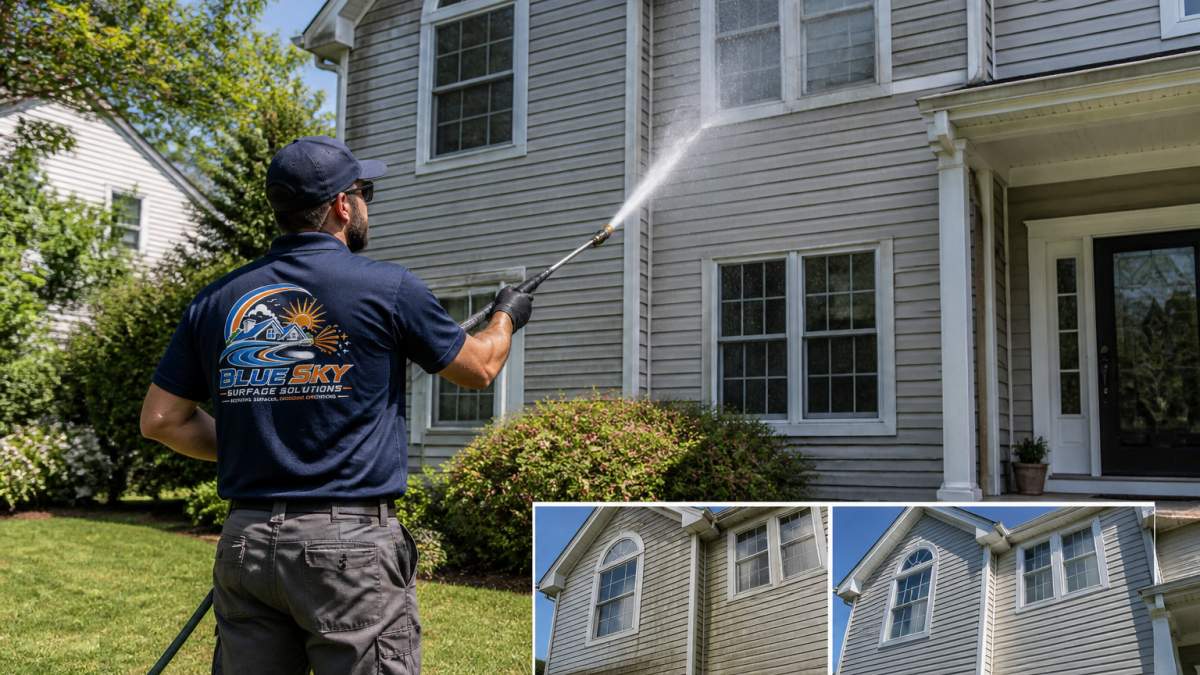
How Long Does It Take to Wash a House?
Weather plays a role too. Wind, rain, and freezing temperatures can delay work, so ask about scheduling flexibility when you request an estimate.
How Often to Wash a House and What That Does to Your Budget
Many homeowners wash their exterior once a year. Homes in shady, humid areas or near trees may need cleaning more often because mildew and algae return faster. Scheduling regular cleanings can keep each job lighter and may reduce the total cost over time, since less buildup means less work per visit.
Think of it as maintenance rather than repair. Consistent cleaning protects your siding and paint, which can help you avoid more expensive restoration later.
Booking Your House Washing Estimate With Blue Sky Surface Solutions
Blue Sky Surface Solutions provides professional house washing. If you are ready to hire, this guide explains how to find a nearby soft wash provider and choose one. Contact us to learn more about our approach and request a quote. If you want to know what your home will cost to clean, contact us for a free quote today.
Frequently Asked Questions
How much does it cost to wash a house?
House washing cost depends mainly on home size, siding material, height of the walls, and how dirty the exterior is. Many quotes are based on square footage or a flat rate for the job. Because prices vary by provider and location, the most reliable way to know your cost is to request a quote from Blue Sky Surface Solutions.
How long does it take to pressure wash a 2,000-square-foot house?
A crew typically needs several hours to wash a home of about 2,000 square feet, though the actual time depends on the number of stories, how much buildup is present, and whether the job includes gutters, windows, or other surfaces. Soft washing is often done more slowly than high-pressure cleaning because it relies on cleaning solution and careful rinsing.
What is the difference between soft washing and pressure washing?
Pressure washing uses high-force water to blast dirt away, which can be too harsh for vinyl, painted, or older siding. Soft washing uses low water pressure combined with a cleaning solution that kills mildew, algae, and stains at the root. Soft washing is usually the better choice for house exteriors, while pressure washing suits hard surfaces like concrete.
How often should I have my house washed?
Many homeowners schedule house washing once a year, though homes in shaded or humid areas may need it more often to control mildew and staining. Regular washing also helps protect the siding and keeps curb appeal strong.