 blog
Residential Tree Services: 2026 Homeowner Guide
Table of Contents
- What Residential Tree Services Actually Cover
- Tree Trimming Cost Factors Every Homeowner Should Know
- Your Residential Tree Maintenance Schedule, Season by Season
- How to Find Certified Arborists You Can Trust
- DIY vs. Professional Risk Assessment: What's Actually at Stake
- Post-Storm Recovery: When to Call for Emergency Tree Service
- Tree Species-Specific Care and Environmental Impact
- Frequently Asked Questions
Last Updated: September 28, 2026
What Residential Tree Services Actually Cover
Residential tree services are the professional care, maintenance, and removal of trees on private property, handled by trained crews with the right equipment and insurance. Homeowners often call only after a limb is already hanging over the driveway, the expensive way to do it.
- Tree removal for dead, hazardous, or overcrowded trees
- Tree trimming and pruning to shape growth and clear structures
- Stump grinding to eliminate the leftover base after removal
- Emergency tree service for storm damage and fallen limbs
- Tree health assessment and disease management
- Debris removal and full site cleanup
Core Services: Removal, Trimming, Stump Grinding, Emergency Response
Removal is the last resort, not the first. A certified arborist can often save a tree through crown reduction, cabling and bracing, or root collar excavation. When a tree is genuinely failing, removal protects your roof, car, and family.
Tree Trimming Cost Factors Every Homeowner Should Know
Pricing depends on the tree, the access, and the risk. Any company that skips the site visit is guessing with your money.
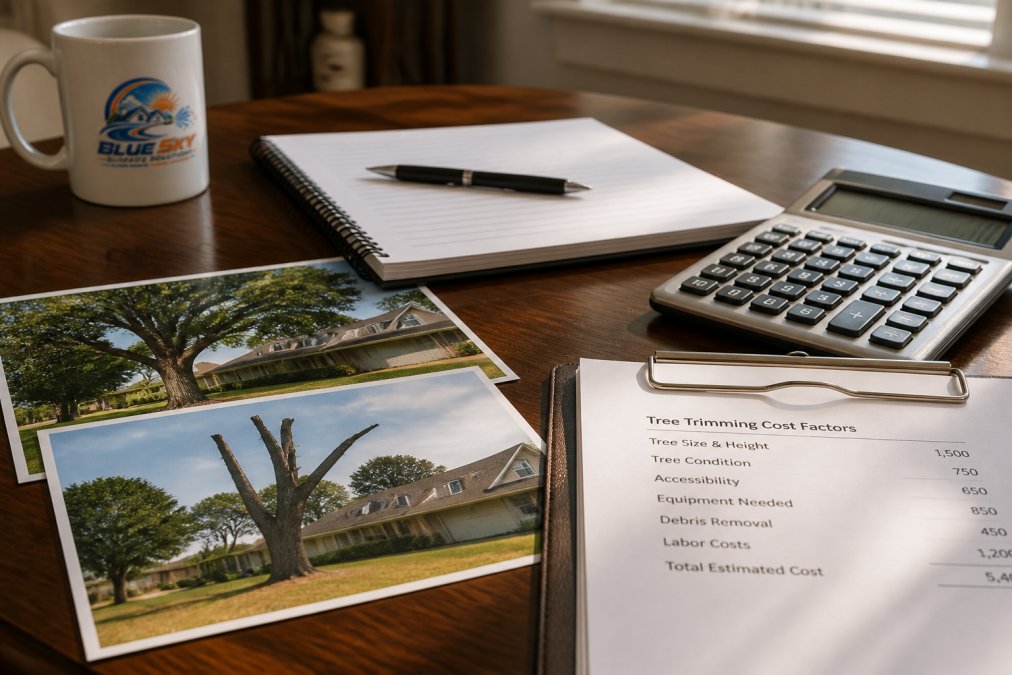
The main tree trimming cost factors are:
| Factor | What It Changes |
|---|---|
| Tree height and spread | Bigger trees need bigger equipment |
| Condition and lean | Hazard trees take longer and more caution |
| Proximity to structures | Tight drops require rigging, not free falls |
| Access to the tree | Backyard trees mean more labor hours |
| Number of trees | Bundled work usually lowers the per-tree rate |
| Debris hauling | Removal and disposal add time and truck space |
How the Factors Actually Move the Number
Many residential tree services companies price by the crew-hour, not by the tree. A two-person crew with a chipper and bucket truck is often the baseline; a third ground worker, a climber instead of a bucket, or a crane can all push the rate up.
A few patterns hold across most jobs:
- Height and spread. A tree under roughly 30 feet can often be handled from the ground or a short ladder. Above that, you pay for a bucket truck or climber, and setup alone can add an hour before any cutting starts.
- Proximity to structures. A tree with a clear drop zone can be felled in sections. One overhanging a roof, driveway, or power drop must be rigged down in pieces, which can double or triple the time.
- Access. A front-yard tree next to the street is fast. One behind a fence, up a slope, or surrounded by landscaping means every branch is carried or winched out by hand.
- Condition. A dead or leaning tree is more dangerous to climb and may require a crane or bucket rather than a climber, changing the equipment lineup and price.
- Volume of debris. Chipping and hauling is a real cost. Leaving chips on site as mulch trims the bill if you have a use for them.
Why Two Quotes for the Same Tree Can Differ by Hundreds
A low bid can sometimes mean a crew that skips safety protocols, carries no liability coverage, or leaves debris on your curb. A higher bid might include a bucket truck, crane, and full site cleanup.
- Is the estimate itemized by service, or is it one lump number?
- Does it state who is responsible for cleanup and hauling?
- Is stump grinding included, or is that a separate line?
- What is the payment schedule, and is any deposit required?
- Is the crew employee or subcontractor?
Where You Can Actually Save
You do not have to accept the first number. Legitimate ways to lower a tree trimming bill:
- Bundle work. Scheduling several trees in one visit spreads the setup and travel cost across more work.
- Schedule in the dormant season. Late winter is the slow season for most crews, and availability is better.
- Keep the chips. If you want mulch for garden beds, ask the crew to leave the chips on site.
- Skip the haul-away on small jobs. If you can dispose of small limbs yourself, say so up front.
Your Residential Tree Maintenance Schedule, Season by Season
A residential tree maintenance schedule beats reactive calls every time. Trees tell you what they need by season, and following that rhythm keeps them healthy and your property safe.
Why the Same Schedule Does Not Fit Every Tree
Most tree care advice treats all trees as interchangeable. They are not. The right pruning window, cutting amount, and fertilization routine depend on species, and getting it wrong can do real damage.
A few common patterns worth knowing:
- Oaks and hickories. Slow growers with strong wood that respond poorly to heavy cutting. Prune lightly and infrequently, ideally in the dormant season; some practitioners avoid pruning oaks in warmer months to reduce pest and disease risk.
- Maples and willows. Fast growers with weaker wood that need more frequent structural pruning to remove weak limbs and competing leaders before they become hazards. Willows shed limbs readily and benefit from regular thinning.
- Pines and other conifers. Never top these or cut heavily into old wood, which does not regrow. Pruning is usually limited to dead, damaged, or conflicting limbs.
- Flowering trees. Pruning timing depends on whether the tree blooms on old wood or new wood. Pruning at the wrong time can cost you a season of blooms.
Matching the Schedule to Your Property
A maintenance schedule is not just about the calendar. It is about what is on your lot and where it sits.
- Trees near the house or driveway. These get inspected more often because the consequences of failure are higher. A limb over a roof is a different risk than a limb over a back fence.
- Trees near power lines. Never prune these yourself. Utility companies and their contractors handle line clearance, and the work has to be coordinated.
- Mature trees. Older trees deserve preservation-focused care. The goal is to keep them healthy and structurally sound, not to reshape them.
- Newly planted trees. Young trees benefit from early structural pruning to establish a strong form, which pays off for decades.
The Case for a Standing Appointment
Homeowners who prioritize regular tree care often schedule an annual inspection. A short dormant-season visit can catch small problems while they are small and provide a written record of the tree's condition over time.
How to Find Certified Arborists You Can Trust
Start with credentials, not price. An ISA certified arborist has passed a formal exam and commits to continuing education, which separates trained professionals from guys with a chainsaw and a truck.
Here is what to verify before you hire:
- Current ISA certification number, which you can look up
- Proof of liability insurance and workers' compensation
- A written, itemized estimate with the scope spelled out
- Local references you can actually call
- A clear answer on who removes the debris
DIY vs. Professional Risk Assessment: What's Actually at Stake
Most homeowners can handle small limbs with a pole saw from the ground. The line gets crossed fast, though, usually lower than people think.
Leave these to professionals:
- Anything within striking distance of power lines
- Limbs larger than your forearm
- Any tree leaning toward a structure
- Work that requires a ladder above head height
- Trees showing cracks, hollows, or fungal growth at the base
Post-Storm Recovery: When to Call for Emergency Tree Service
Call for emergency tree service the moment a tree or large limb is resting on a structure, blocking access, or hanging over anything you value. Those are not wait-until-Monday problems.
- Make sure everyone is clear of the area
- Photograph the damage before touching anything
- Call your insurance company if a structure is involved
- Keep people and pets away from leaning or partially fallen trees
- Schedule professional removal and site cleanup
Tree Species-Specific Care and Environmental Impact
Different trees need different care, and treating them all the same is a common mistake. Fast growers like maples and willows need more frequent pruning because their wood is weaker. Oaks and hickories grow slowly and respond badly to heavy cutting, so crown reduction should be light and infrequent.
Frequently Asked Questions
What services are included in professional residential tree care?
Professional residential tree services typically cover tree removal, trimming and pruning, stump grinding, emergency response, and ongoing health assessments. Many providers also offer canopy thinning, deadwooding, tree cabling and bracing, root collar excavation, and debris removal. When you request a free estimate, ask exactly which tasks are included so you can compare quotes fairly. A licensed and bonded company should also carry liability insurance and workers' compensation for every crew member on your property.
How often should you have your trees professionally trimmed?
Most mature trees benefit from professional trimming every three to five years, though fast-growing species may need attention every two years. Your residential tree maintenance schedule should also include an annual health assessment, ideally in late winter or early spring before new growth begins. Dead, diseased, or crossing branches should be removed as soon as you notice them rather than waiting for the next scheduled visit. An ISA certified arborist can recommend a timeline based on your specific tree species and site conditions.
How do I know if a tree on my property is hazardous?
Warning signs include large dead branches, deep cracks in the trunk, mushrooms growing at the base, and soil heaving around the roots. A tree that has recently started leaning, especially after a storm, also warrants an immediate hazard tree evaluation. If you spot any of these signs, contact a licensed tree service for an evaluation before the situation worsens.
What is the difference between tree trimming and tree pruning?
Trimming generally refers to cutting back overgrown branches for appearance, clearance, or size control. Pruning is more selective and focuses on the tree's long-term health: removing deadwood, thinning the canopy for airflow, and eliminating diseased or crossing limbs. Both practices require different techniques and timing, and doing either incorrectly can damage a tree permanently. Tree topping, for example, is a harmful practice that weakens structural integrity. An ISA certified arborist can determine which approach your trees need.
Tree care is one of those things that is easy to postpone until a storm makes the decision for you. Blue Sky Surface Solutions handles residential tree services across Hamilton County, from scheduled tree trimming and stump grinding to emergency response after a storm. Our team pairs that work with house and gutter cleaning, soft washing, and full debris removal, so one call covers the whole exterior. Request a free quote and get a clear, itemized estimate before any work begins.