 how-to
What to Pay a House Cleaner: A 2026 Pricing Guide
Table of Contents
- What Should I Pay a Person to Clean My House?
- House Cleaning Cost: Hourly Rates vs. Flat Rates
- Factors That Affect What You Pay a House Cleaner
- How Long Does It Take to Clean a House?
- How to Get a House Cleaning Quote
- House Cleaning Checklist: Agree on Scope Before You Agree on Pay
- Tips, Cancellation Fees, and Payment Etiquette
- Employee vs. Independent Contractor: What Homeowners Should Know
- Frequently Asked Questions
Last Updated: October 18, 2026
What Should I Pay a Person to Clean My House?
What you pay a person to clean your house depends on three things: how big the home is, how dirty it is, and how often you book.
This guide from Blue Sky Surface Solutions breaks down house cleaner pay the way we would explain it to a neighbor.
Here's what most guides get wrong: they hand you a national average and stop. That average tells you nothing about your three-bedroom ranch with two dogs.
House Cleaning Cost: Hourly Rates vs. Flat Rates
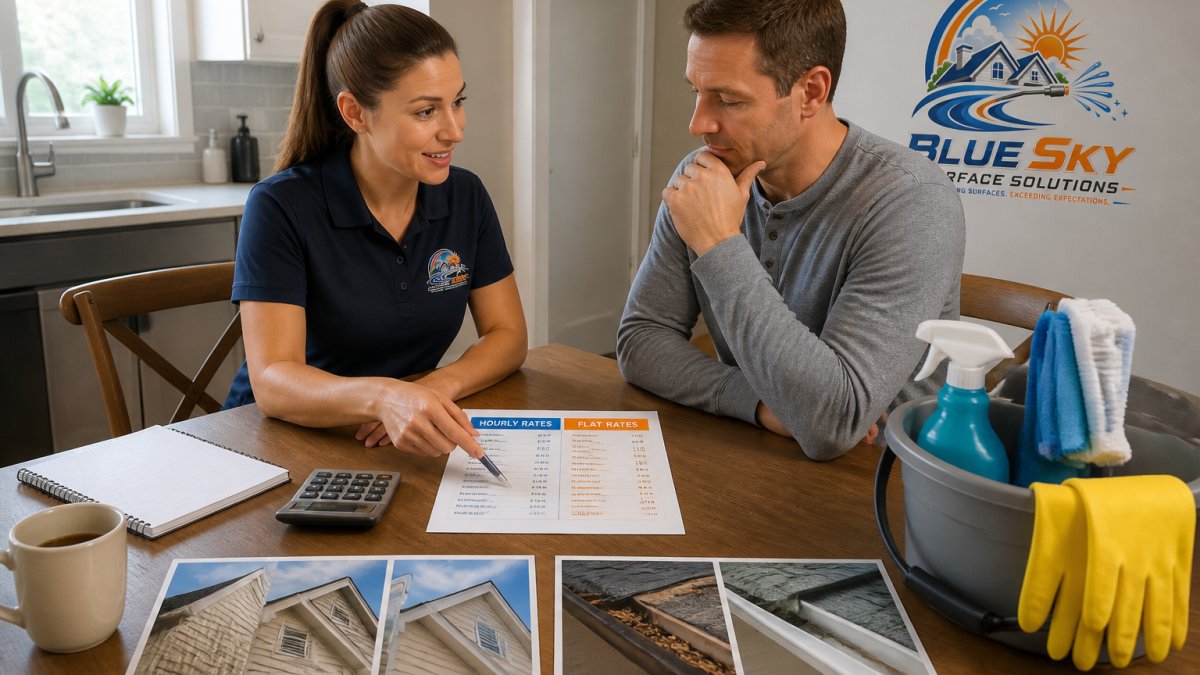
House cleaning cost comes in two shapes: an hourly rate or a flat rate per visit. Hourly pricing pays for time. Flat pricing pays for the job.
When an Hourly Rate Makes Sense
Hourly rates fit homes in rough shape or jobs with an unclear scope. If the cleaner has never seen your house, an hourly rate protects them from a four-hour surprise. It also protects you when a job turns out smaller than expected.
The catch is that hourly pricing rewards slow work. Ask for a time estimate before you agree, and check it against the job once it's finished.
When a Flat Rate Saves You Money
Flat rates fit repeat visits with a known scope. Once a cleaner knows your home, a per-visit price caps your cost no matter how the day goes. Most recurring cleaning runs on flat rates for exactly this reason.
Ask one question before you sign: what happens if the visit runs long? A good flat rate includes a scope list so neither side argues about extras later.
Factors That Affect What You Pay a House Cleaner
Several factors move house cleaner pay up or down, and none of them is mysterious. Home size, condition, and frequency do most of the work. The type of clean and the add-ons you request handle the rest.
Home Size, Condition, and Frequency
Square footage and room count set the baseline. More bedrooms, more bathrooms, and more rooms mean more time. Condition is the wild card: a well-kept home cleans faster than one that's been neglected for months.
Frequency changes the math in your favor. Weekly and biweekly cleaning usually costs less per visit than one-time cleaning, because the home never gets far behind. Monthly cleaning sits in the middle.
Standard Cleaning vs. Deep Cleaning
Standard cleaning covers maintenance: dusting, vacuuming, mopping, bathroom cleaning, and kitchen cleaning on visible surfaces. Deep cleaning adds the slow work: baseboards, inside appliances, and buildup that standard visits skip.
Expect deep cleaning to cost more per visit than standard cleaning. It takes longer, and it's usually a one-time reset before you move to a recurring schedule.
| Pricing Factor | What It Changes | Effect on Pay |
|---|---|---|
| Home size | Time on task | Larger homes cost more per visit |
| Condition | Starting point | Heavier buildup costs more |
| Frequency | Per-visit rate | Weekly and biweekly cost less per visit |
| Clean type | Scope of work | Deep cleaning costs more than standard |
| Add-ons | Extra tasks | Each add-on adds time and pay |
How Long Does It Take to Clean a House?
A standard clean on an average home takes roughly two to four hours for one person. Deep cleaning and first-time visits run longer.
Time is the backbone of any pay estimate. If you know the hours and the hourly rate, you know the price.
A practical way to build your own number: multiply estimated hours by the hourly rate you've agreed on, then add a buffer for the first visit.
How to Get a House Cleaning Quote
To get a house cleaning quote, give the cleaner three things: your home size, your condition, and your frequency. Vague requests get vague quotes. Specific ones get numbers you can compare.
Most cleaners will ask for a walkthrough or a video tour. Say yes. A quote built on a real look at your home beats a phone estimate every time.
Build Your Own Estimate Before You Call
The strongest negotiating position is a number you built yourself. Use this simple method:
- Count the rooms. Note bedrooms, bathrooms, kitchen, living areas, and any finished basement or bonus room.
- Assign time per room. A common planning pattern is roughly 20 to 30 minutes per bathroom, 30 to 45 minutes per bedroom, and 45 to 60 minutes for a kitchen, depending on condition. Living areas and hallways add time for vacuuming and mopping.
- Add condition time. A home that hasn't been cleaned in months, or one with pets and heavy clutter, adds time. A well-kept home trims it.
- Multiply by the hourly rate you've been quoted, then add a first-visit buffer of about an hour.
Example: a three-bedroom, two-bath home in average condition might plan for about three hours for one cleaner. At an hourly rate of $40, that's roughly $120 for the visit, plus a buffer on the first clean.
That estimate is your anchor. When a quote comes in far above or below it, you now have a specific question to ask: which rooms, which tasks, and how many hours are behind that number?
Compare Quotes Like for Like
When quotes arrive, compare them on the same five points:
- Same scope list (which rooms, which tasks)
- Same frequency (weekly, biweekly, monthly, one-time)
- Supplies included or billed separately
- Same add-ons priced the same way
If two quotes differ wildly, the scope usually explains it. Ask each cleaner to walk you through their list before you decide. A lower hourly rate with a longer estimated visit can cost more than a higher rate with a tight scope, so compare the total per visit, not the rate alone.
When you're ready to lock in a fair price without the guesswork, contact us for a free quote.
House Cleaning Checklist: Agree on Scope Before You Agree on Pay
A house cleaning checklist turns a vague agreement into a clear one. Write down what's included, what costs extra, and what nobody touches. Both sides sign off on the same list, and the money conversation gets much shorter.
Use this as your starting scope sheet:
- Dusting: all reachable surfaces, shelves, and blinds
- Vacuuming: carpets, rugs, and under furniture where possible
- Mopping: hard floors in kitchen, bathrooms, and entryways
- Bathroom cleaning: sinks, toilets, tubs, showers, mirrors
Price the extras separately: baseboards, inside appliances, inside cabinets, windows, and laundry. If it isn't on the list, assume it isn't included.
Tips, Cancellation Fees, and Payment Etiquette
Payment etiquette is where good working relationships live or die.
Tipping is optional and never required. A common approach is a modest tip for a first deep clean or a holiday thank-you.
Cancellation fees protect the cleaner's schedule. A short-notice cancellation often means lost income for that slot.
One more habit worth building: leave the home ready. Clutter adds time, and time adds cost.
Employee vs. Independent Contractor: What Homeowners Should Know
The person cleaning your home is usually either an employee of a cleaning company or an independent contractor.
With a cleaning company, the business employs the cleaner. The company carries insurance, handles payroll taxes, and manages scheduling.
With an independent contractor, you hire the person directly.
Which is better? It depends on what you want. A company offers backup coverage when your regular cleaner is out.
Agree on Pay With an Independent Cleaner
Hiring a person directly puts more of the arrangement on you, so put the important terms in writing before the first visit. A short message or one-page agreement covering the points below prevents most disputes.
- Scope: List the rooms and tasks included, and name the extras that cost more. Use the checklist in this guide as your starting point.
- Time and rate: Confirm the hourly rate or flat per-visit price, the estimated hours, and what happens if the visit runs long.
- Supplies: Decide who provides products and equipment. Some cleaners bring their own and build that into the rate; others use yours. Agree before the first clean so nobody arrives empty-handed.
- Payment terms: Confirm the amount, the method, and when payment is due. Many independent cleaners expect payment at the end of each visit, while some prefer a recurring transfer. Ask rather than assume.
- Access and scheduling: Agree on arrival windows, how the cleaner gets in, and the notice window for cancellations.
Employee vs. Contractor: A Quick Comparison
| Consideration | Cleaning Company | Independent Cleaner |
|---|---|---|
| Who you pay | The company | The cleaner directly |
| Insurance | Carried by the company | Ask the cleaner to confirm |
| Taxes and payroll | Handled by the company | Handled by the cleaner |
| Backup coverage | Usually available | Depends on the individual |
| Scheduling flexibility | Set by the company | Often more flexible |
| Supplies | Usually provided | Confirm who provides |
That's the whole method: estimate hours, agree on scope, pick hourly or flat, and put the terms in writing. Do that, and house cleaner pay stops being a guessing game. If you'd rather skip the paperwork and the back-and-forth, contact us for a free quote.
Frequently Asked Questions
Should I pay a house cleaner by the hour or by the job?
Hourly pay works well for one-time or deep cleaning where the scope is uncertain, because you pay for the actual time spent. Flat-rate pricing is better for recurring standard cleaning since you know the house cleaning cost upfront and the cleaner is motivated to work efficiently. Ask for both options in your quote, then compare them like-for-like using the same house cleaning checklist so you are not comparing a light tidy against a full deep clean.
How do I get a quote for house cleaning?
Start by describing your home accurately: square footage, number of bedrooms and bathrooms, current condition, and whether you want standard, deep, move-in, or move-out cleaning. Ask whether the quote is hourly or flat rate, what tasks are included, and whether supplies and equipment are provided. Request the quote in writing and confirm cancellation terms. Getting two or three quotes on the same scope is the fastest way to see what local rates actually look like and to spot outliers.
How long does it take to clean a house?
Time depends on home size, condition, and cleaning type. A standard clean on a well-kept smaller home may take a few hours, while a first-time deep clean on a larger or neglected home can take considerably longer, sometimes across two visits. Recurring weekly or biweekly cleaning usually takes less time per visit once the home is maintained. Ask the cleaner to estimate hours in the quote so you can sanity-check an hourly rate against a flat-rate price.
Should I tip a house cleaner?
Tipping is optional but appreciated. For recurring service, many homeowners tip around the cost of one visit at the holidays rather than every visit. For one-time or deep cleaning, a small tip of 10 to 15 percent is common if the work exceeded expectations. If you hire an independent cleaner directly, a tip is not expected but a positive review and reliable payment matter just as much. Always confirm payment method and timing before the first visit.
Cleaning the inside of your home is one job. Keeping the outside looking its best is another, and that's where we come in. Blue Sky Surface Solutions handles house washing, gutter cleaning, soft washing, and tree services across Hamilton County, with dependable scheduling and workmanship that protects your investment. If your exterior needs attention this season, request a free quote from Blue Sky Surface Solutions and get a clear plan for your property.