 listicle
Signs Your Trees Need Professional Trimming: 2026 Guide
Table of Contents
- Dead Branches and Other Obvious Signs Your Trees Need Professional Trimming
- When Tree Branches Are Too Close to Your Roof and Siding
- Tree Trimming Safety Hazards: Why DIY Can Be Dangerous
- When to Hire a Professional Arborist Instead of Doing It Yourself
- How Professional Tree Trimming Improves Curb Appeal and Property Value
- Seasonal Timing: The Best Time of Year for Tree Trimming
- Frequently Asked Questions
Last Updated: September 21, 2026
Dead Branches and Other Obvious Signs Your Trees Need Professional Trimming
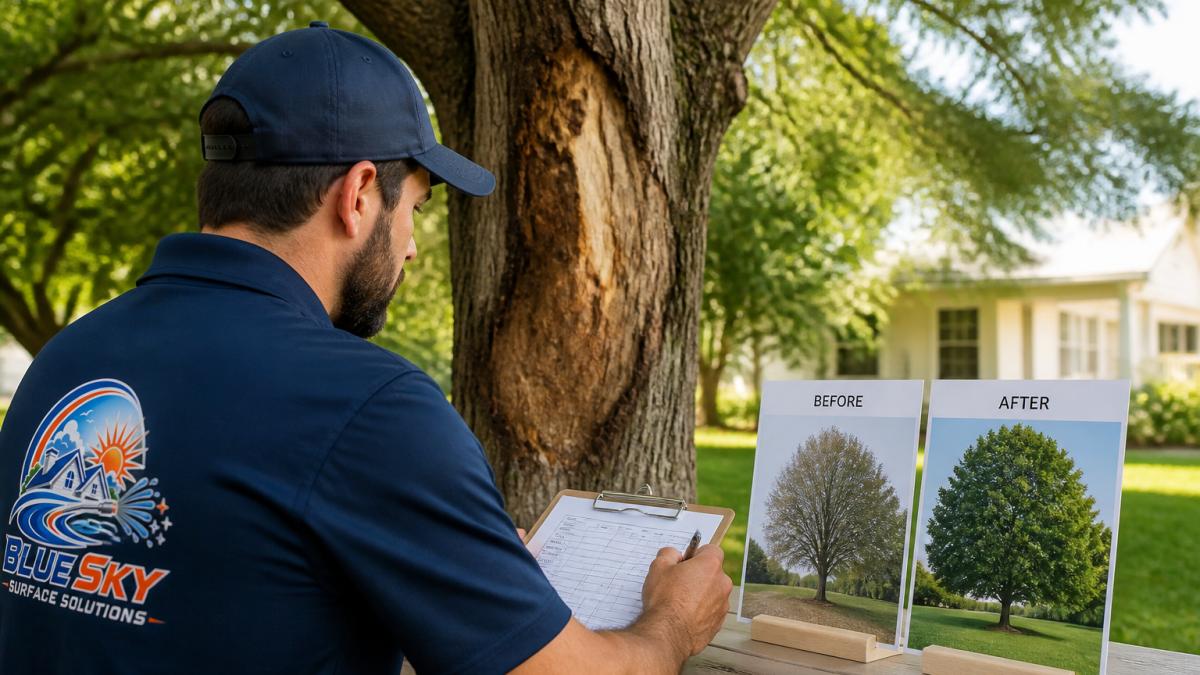
Dead branches are the clearest signs your trees need professional trimming. When limbs lose their bark, snap easily, or hang at odd angles, the tree is telling you something is wrong. A single dead limb over a driveway, a cracked trunk, and suddenly a routine maintenance item becomes an emergency.
A dead branch can drop without warning, and the risk climbs fast once decay reaches the trunk. The five warning signs below cover most of what homeowners miss:
- Bare, brittle limbs that snap when you bend them
- Bark peeling away from the wood underneath
- Deep cracks or splits running down the trunk
- Mushrooms or fungal growth at the base
- Branch unions shaped like a tight "V" instead of a strong "U"
That last one matters more than most people realize. A tight V-shaped union traps bark between two limbs, which weakens the joint over time.
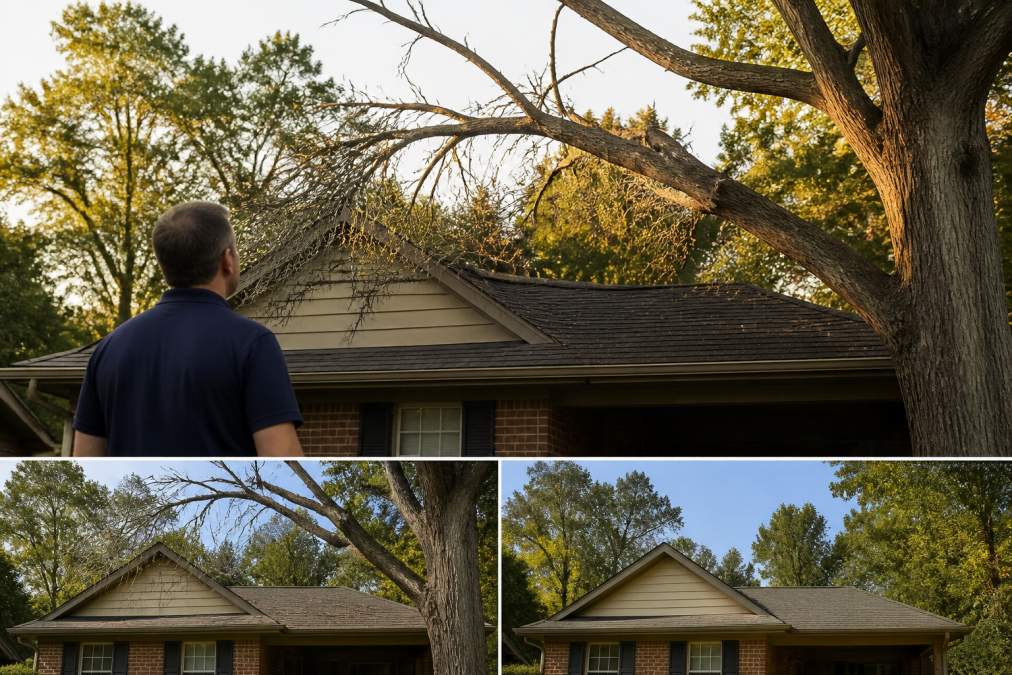
Spotting Deadwood Before It Falls
Test a suspect branch with a light tug. If it snaps instead of bending, it is already dead. Live wood flexes; dead wood gives way.
Cracks, Splits, and Weak Branch Unions
Cracks in the trunk are a structural red flag. Once a split reaches the main stem, the tree may need cabling or removal rather than a simple trim.
When Tree Branches Are Too Close to Your Roof and Siding
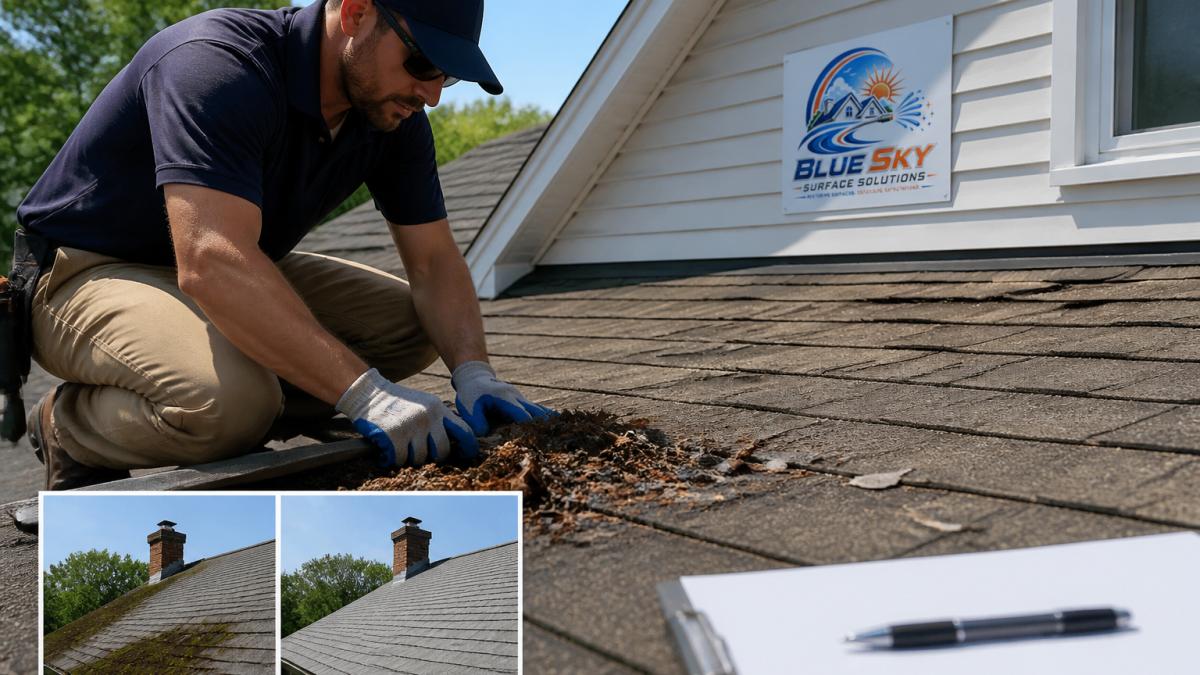
Tree clearance from roof and siding is a safety issue, not just a cosmetic one. Branches that touch or hover over your home rub against shingles, trap moisture, and give squirrels and raccoons a direct path to your attic.
The damage adds up quietly. Constant contact scrapes away shingle granules, and the loss of that protective layer shortens your roof's lifespan. On the siding side, shade and trapped dampness encourage algae and mildew growth, which is exactly the kind of buildup that soft washing is designed to remove.
How Overhanging Limbs Damage Your Home's Exterior
Limbs that scrape siding wear through paint and leave the surface open to moisture. Left alone, that moisture feeds the algae and mildew streaks you see on north-facing walls.
Tree Trimming Safety Hazards: Why DIY Can Be Dangerous
Tree trimming safety hazards are real, and they are the main reason this job belongs to a professional. The Occupational Safety and Health Administration guidance on tree care treats tree work as high-risk labor for good reason: falls, chain saw injuries, and electrocution are the three leading dangers.
Power lines top the list. A limb that looks clear of a line can still conduct through wet wood, and no homeowner should be within ten feet of an energized conductor. Falls are the second hazard. Even a modest height becomes dangerous when you are balancing on a ladder with a running saw in one hand.
- Never work near power lines, period
- Skip the ladder for anything above a few feet
- Wear a hard hat, eye protection, and cut-resistant gloves
- Keep both hands on the saw and both feet on solid ground
When to Hire a Professional Arborist Instead of Doing It Yourself
Hire a professional arborist when a job involves power lines, heights above a few feet, large limbs, or a tree that is already failing. Those four conditions cover the vast majority of dangerous work, and they are exactly the situations where a trained crew earns its cost.
But "hire a pro" is easy advice to give and hard advice to follow, because not every crew that shows up with a chipper is a professional. The difference between a certified arborist and a weekend operator is not just skill, it is insurance, liability, and accountability. That distinction is the single most important thing to understand before you sign anything.
What an Arborist Actually Brings to the Job
An arborist brings more than a ladder and a saw. They read a tree's structure, identify disease, and know which cuts heal cleanly versus which ones invite rot. They also understand species-specific growth habits, why a silver maple needs different pruning than an oak, and why topping a tree (cutting it back to stubs) is almost always the wrong move even though it looks like a quick fix.
That knowledge matters because a bad cut does not just look ugly. It creates an open wound that decays slowly over years, long after the crew has packed up and left. By the time the damage is visible, the tree may be past saving.
Insurance and Liability: The Question Most Homeowners Forget to Ask
This is the part of the conversation that separates a real professional from a risky gamble. If a homeowner drops a limb through a neighbor's fence, the repair bill lands on the homeowner. A licensed, insured crew carries that risk instead. Insurance Information Institute guidance on homeowners liability explains how property damage claims work when a falling limb hits a neighbor's property.
There are two separate coverages to confirm, and they are not the same thing:
- General liability insurance covers property damage, your roof, your neighbor's fence, a parked car.
- Workers' compensation covers injuries to the crew. Without it, an injured worker can pursue a claim against you as the property owner.
Ask for a certificate of insurance and call the insurer to confirm it is active. A legitimate company expects this question and answers it without hesitation.
Three Questions That Separate a Pro from a Weekend Operator
Asking three questions separates a real professional from a weekend operator:
- Are you insured, and can I see proof?
- Do you have ISA certification or equivalent training?
- Will you provide a written service estimate before work begins?
The Long-Term Value of Doing It Right
A properly pruned tree lives longer, drops fewer limbs, and costs less to maintain over its lifetime. A tree that is butchered by an unqualified crew often needs removal years earlier than it should, and removal costs far more than pruning ever would have. When you weigh the two paths, the professional route is not just the safer choice. It is usually the cheaper one over the life of the tree.
How Professional Tree Trimming Improves Curb Appeal and Property Value
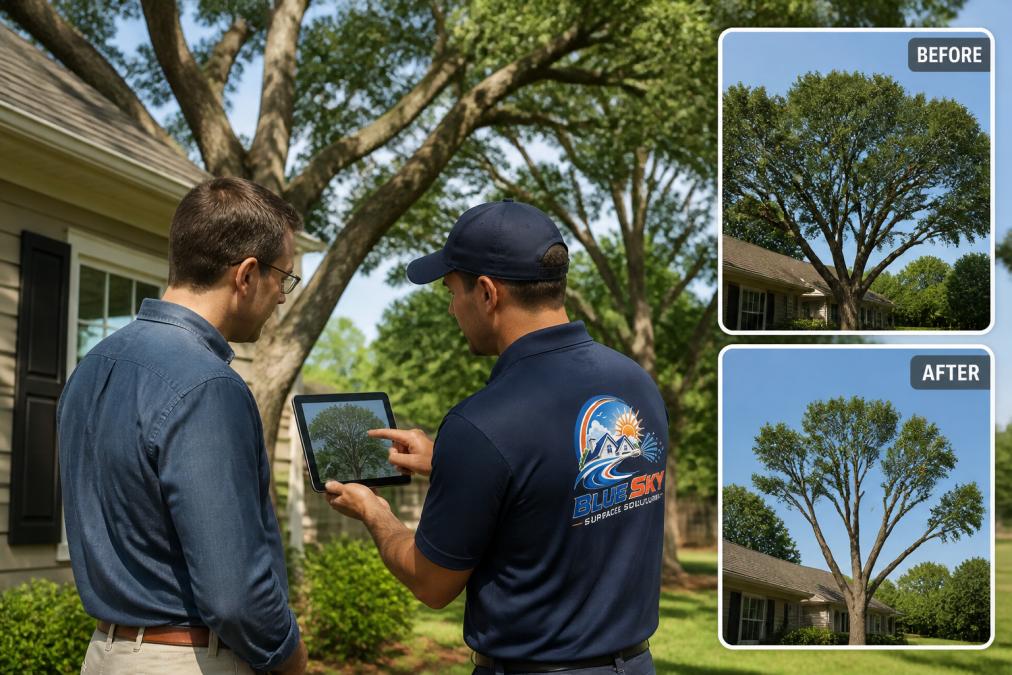
Healthy, well-shaped trees lift curb appeal in a way few other improvements match. Overgrown, dying, or storm-damaged trees do the opposite: they signal neglect to every buyer who drives past.
Seasonal Timing: The Best Time of Year for Tree Trimming
Late winter is the best time for most tree trimming, while the tree is dormant and before spring growth begins. Pruning during dormancy lets the tree heal faster and makes the branch structure easier to see without leaves in the way.
| Situation | Best Timing | Why It Matters |
|---|---|---|
| Routine structural pruning | Late winter | Dormant tree heals faster |
| Dead or hazardous limbs | Immediately | Reduces fall risk |
| Storm damage | As soon as possible | Prevents further splitting |
| Flowering trees | After bloom | Protects next season's flowers |
| Evergreens | Early spring | Avoids cold-weather stress |
| Oaks (most species) | Late winter | Reduces risk of oak wilt spread |
| Maples and birches | Late spring to early summer | Avoids heavy sap bleed from winter cuts |
Why Timing Is Really About Long-Term Cost
Most guides treat timing as a one-time decision. It is not. The timing you choose this year shapes what the tree costs you over the next decade.
Pairing Trimming with the Rest of Your Exterior
Frequently Asked Questions
What are the warning signs that a tree is dying?
Key signs include large dead branches, cracks in the trunk, fungal growth at the base, and sparse or discolored leaves during the growing season. If you notice these, especially after storm damage, call a professional arborist. They can assess whether the tree can be saved or if it poses a safety hazard to your home.
How close to a house should tree branches be?
Branches should ideally be at least 6 to 10 feet away from your roof and siding to prevent damage from rubbing, moisture buildup, and pest access. If limbs are touching or overhanging, schedule professional trimming. This also improves tree clearance from roof and siding, reducing the risk of costly repairs.
When is the best time of year to trim trees?
Late winter or early spring is generally best for most trees, while they are dormant. This minimizes stress and reduces the risk of disease. However, dead or hazardous branches should be removed immediately, regardless of season. Always consult a professional arborist to determine the ideal timing for your specific tree species.
Can over-trimming a tree kill it?
Yes, removing more than 25% of a tree's canopy in one season can stress it severely, making it vulnerable to disease and pests. Improper cuts can also lead to decay. Professional arborists know how to trim safely, preserving the tree's health while addressing safety hazards and clearance issues.