 how-to
How to Safely Prune Trees Near Power Lines
Table of Contents
- Why Pruning Trees Near Power Lines Is a Job for Trained Professionals
- Who Trims Trees Near Power Lines: Homeowner vs. Utility Responsibility
- What to Do When a Tree Touches a Power Line
- Tree Pruning Safety Equipment: What Line-Clearance Crews Use
- Utility Line Clearance Tree Trimming: What to Expect on Your Property
- Safe Clearance Distances and How Professionals Prune Near Energized Wires
- Planting Smart: Species Selection and Long-Term Prevention
- Conclusion: Protect Your Property with Professional Tree Care
- Frequently Asked Questions
Last Updated: October 9, 2026
Why Pruning Trees Near Power Lines Is a Job for Trained Professionals
Learning how to safely prune trees near power lines starts with one honest answer: you don't. You hire someone trained for it.
Overhead lines carry enough current to kill.
So why is this different from normal tree trimming? Three reasons:
- You cannot see whether a line is live. Lines that look dead often are not.
- Wood is not a safe insulator. A dry branch can carry current straight to you.
- Aluminum ladders and pole saws conduct electricity. They turn a small mistake into a fatal one.
Utility companies and university extension programs all give the same guidance: keep every part of your body and every tool well away from overhead lines. The safe distance is measured in feet, not inches.
Who Trims Trees Near Power Lines: Homeowner vs. Utility Responsibility
The answer depends on which line the tree is near.
Distribution lines carry power down your street; the electric utility owns them and trims the trees around them. Service lines run from the pole to your house, the homeowner is usually responsible for nearby trees, but the utility controls what happens near the wire itself. Communications lines carry phone, cable, and internet, sit lower, and belong to those providers.
Here is the split in plain terms:
| Line Type | Who Owns It | Who Handles Tree Work Near It |
|---|---|---|
| Distribution lines | Electric utility | Utility vegetation crews |
| Service lines (pole to house) | Homeowner, with utility oversight | Utility or a qualified pro |
| Communications lines | Phone, cable, internet providers | The provider |
How to Identify Distribution Lines, Service Lines, and Communications Lines
Look at where the line goes and how high it sits. Distribution lines run pole to pole along the street at the top of the pole. Service lines drop from a pole to a single building. Communications lines are usually the lowest wires and often bundle together. If you cannot tell them apart, call your electric utility.
What to Do When a Tree Touches a Power Line
Treat every contact between a tree and an overhead line as an emergency until the utility says otherwise. The reason is step potential: when current enters the ground from a downed or arcing conductor, voltage drops across the surface in concentric rings, and walking across them lets current travel up one leg and down the other. The danger zone is the ground itself, not just the wire.
The Emergency Sequence
- Do not touch anything. Not the tree, branch, fence, metal gate, or garden hose near the contact point. Assume the tree, soil, and anything bonded to them can carry current.
- Call 911 if the line is down, sparking, smoking, burning, or if anyone is injured. Say clearly: "A power line is down and a tree is involved." Give the nearest street address and cross street.
- Call your electric utility to report the location. Use the outage or emergency number printed on your bill or posted on the utility's website, not the general customer-service line.
- Move everyone back at least 30 feet, more if the line is on the ground or the ground is wet. Keep children and pets inside, and call or text neighbors instead of approaching them.
- If you are already inside the danger zone, shuffle. Keep both feet on the ground, do not lift either foot, and slide your feet without breaking contact with the surface until you are clear. Do not run.
- If a vehicle is involved, stay inside it unless it is on fire. If you must exit, jump clear with both feet together and shuffle away without touching the vehicle and the ground at the same time.
- Wait for the utility to confirm the line is de-energized. Only then should anyone touch the tree or begin cleanup.
- Call a qualified tree service after the utility clears the scene. The tree may still be unstable, and the utility will not remove it for you.
What to Say When You Call
Have these details ready so the dispatcher can send the right crew:
- The exact address or nearest pole number, usually stamped on a metal tag on the pole.
- Whether the line is on the ground, a vehicle, a structure, or still overhead.
- Whether you see sparks, smoke, or fire.
If a Branch Falls on a Power Line: What Not to Do
- Do not pull the branch with a rope from a distance, a wet rope can conduct.
- Do not spray water on a smoking line or a burning tree near a line.
- Do not let anyone, including a neighbor with a chainsaw, start cutting before the utility gives the all-clear.
Once the utility confirms the line is safe, the tree still needs an assessment. Contact with an energized conductor can leave hidden cracking, split unions, or a compromised root plate, work for a trained crew, not a homeowner with a pole saw.
Tree Pruning Safety Equipment: What Line-Clearance Crews Use
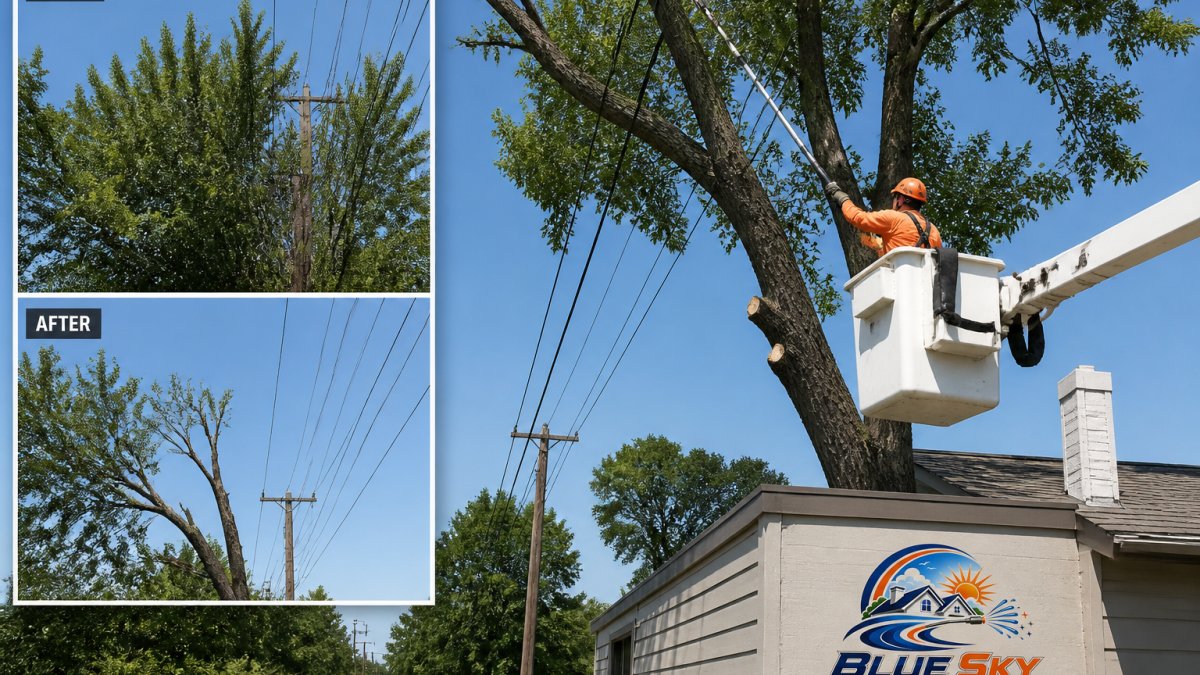
Line-clearance crews wear and carry gear most homeowners never see, because the work happens near energized wires and the margin for error is zero.
- Nonconductive tools. Fiberglass pole pruners and insulated handles keep current away from the hands.
- Rubber insulating gloves and sleeves. These are tested and rated for specific voltages.
- Dielectric boots and hard hats. They protect against shock and falling limbs.
A homeowner with a pole saw has none of this. The equipment is not a nice-to-have, it is the difference between a clean cut and a trip to the hospital.
Utility Line Clearance Tree Trimming: What to Expect on Your Property
Utility line clearance tree trimming keeps branches away from utility lines. It is not cosmetic pruning, the goal is clearance and reliability, not the shape of your tree.
Here is what usually happens:
- You get notice. Utilities or their contractors typically leave a door hanger or letter before work starts.
- Crews assess the tree. They look at growth direction, species, and how close branches sit to the wires.
- They make directional cuts that guide future growth away from the line.
A common mistake is expecting the utility to shape your tree for looks. They will not, their job is keeping the lights on and the public safe.
Safe Clearance Distances and How Professionals Prune Near Energized Wires
Clearance is the distance between a branch and a wire. Professionals keep it large enough that wind, ice, and growth cannot close the gap. The exact number depends on voltage, so there is no single figure a homeowner can safely apply.
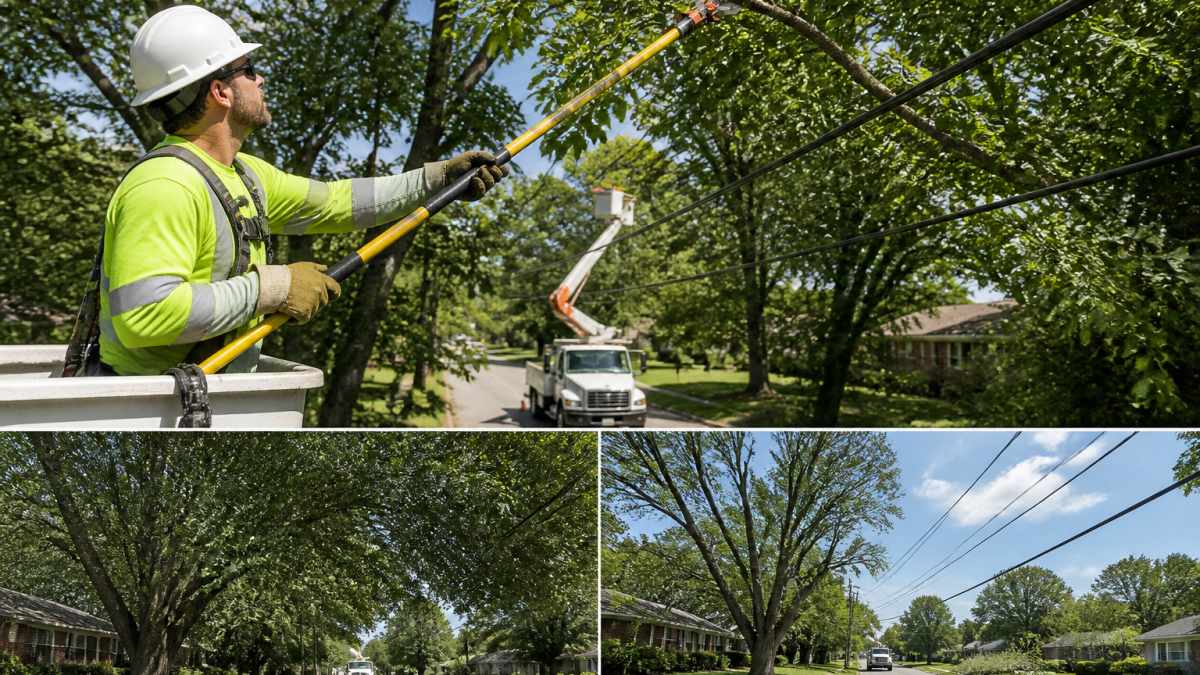
The pruning method matters as much as the distance.
Two things to know about how cuts are made:
- The branch collar. That is the swollen area where a branch meets the trunk. Cuts made at the collar heal well.
- The branch bark ridge. The raised ridge of bark on top of the union. A proper cut leaves it intact.
Bad cuts leave a stub or a flush cut, inviting decay and weak regrowth that pushes out fast, upright shoots straight back toward the wire.
Planting Smart: Species Selection and Long-Term Prevention
The cheapest way to avoid line conflicts is to plant the right tree in the right place. Prevention beats pruning, and it is the one part of this topic a homeowner fully controls.
Start with mature height, not the size of the sapling in the pot. A tree that looks small now can grow into the wires in a decade. A useful rule of thumb used by many utility vegetation programs and extension services:
- Under 25 feet at maturity: suitable for planting under or near distribution lines.
- 25 to 40 feet: plant at least 20 feet away from distribution lines; fine near service drops if sited carefully.
- Over 40 feet: plant well away from any overhead line, typically 50 feet or more, depending on the species' spread.
Species That Stay Low
If you want a tree near a line, choose one that tops out short. Commonly recommended low-maturity options include:
- Flowering dogwood (Cornus florida), usually 15 to 25 feet.
- Eastern redbud (Cercis canadensis), usually 20 to 30 feet.
- Serviceberry (Amelanchier species), often 15 to 25 feet.
Avoid tall, fast-growing species near lines: silver maple, willow, poplar, cottonwood, and most pines and spruces. Utilities prune these most often, and repeated severe cuts can shorten a tree's life.
Match the Tree to the Site, Not Just the Height
Mature height is only half the equation. Also check:
- Spread. A 25-foot tree with a 30-foot canopy still reaches the wire.
- Growth rate. Fast growers need more pruning, more often.
- Wood strength. Weak, V-shaped unions shed limbs in storms; strong, U-shaped unions hold together better.
Use the Free Resources Utilities Already Publish
Most electric utilities publish a right-of-way planting guide or compatible tree list for their territory, telling you which species the utility will leave alone and how far from the wire to plant each one. Ask for it when you call about a tree question, or look under "vegetation management" or "tree planting" on the utility's website. Many utilities also run a tree-planting or tree-replacement program offering low-growing species, sometimes at reduced cost, to homeowners who remove a problem tree near a line.
Call 811 Before You Dig
If you are planting anywhere near the service drop or meter, call 811 before you dig. The free service marks underground electric, gas, water, and communications lines so you do not hit one with a shovel. It is required by law in most states.
The Long Game
A tree planted in the wrong spot becomes a recurring problem: repeated severe cuts push out fast, upright shoots straight back toward the wire, the exact cycle utilities try to break. Choosing the right species once saves years of trimming, keeps your tree healthier, and keeps your family away from energized lines.
Conclusion: Protect Your Property with Professional Tree Care
Trees near power lines are not a do-it-yourself job. The risk to you and your family is too high, and the work calls for training and equipment most homeowners do not have.
At Blue Sky Surface Solutions, we offer expert tree services alongside our house and gutter cleaning and soft washing.
Get a free quote from Blue Sky Surface Solutions and let us handle the tree work safely.
Frequently Asked Questions
Can I prune a tree that is close to a power line?
No. Pruning any tree within 10 feet of an energized power line requires a trained line-clearance worker with insulated tools. Homeowners should never use ladders, pole saws, or ropes near overhead lines because contact or even close approach can cause electrocution. If branches are encroaching on the lines, contact your electric utility or a qualified tree-care professional to assess the situation and perform the work safely.
Who should I call if a tree is touching a power line?
Call your electric utility first. They handle vegetation management on distribution lines and will dispatch a crew if the tree poses a hazard to service reliability or public safety. If the tree is on your side of the service drop, the utility may still advise you to hire a qualified tree-care professional. Never attempt to move branches or climb near the line yourself.
What should I do if a branch falls on a power line?
Stay at least 30 feet away from the downed wire and anything it touches, including fences and vehicles. Call 911 and your utility immediately. Do not attempt to move the branch or use a tool to push it away. If the line is arcing or smoking, evacuate the area and warn neighbors to stay back until utility crews arrive and confirm the line is de-energized.
How far should tree branches be from power lines?
The recommended safe distance varies by line voltage, but as a general rule, keep branches at least 10 feet away from distribution lines and 15 feet from higher-voltage transmission lines. During planting, choose species whose mature canopy will not reach within that clearance. Your utility can provide specific guidance for the lines serving your property.